UPPSC LT Grade Important Topics
Rajasthan Public Service Commission (RPSC) Grade B: The UPPSC LT Grade Exam is a highly competitive teaching examination conducted by the Uttar Pradesh Public Service Commission (UPPSC). Designed to recruit skilled teachers for secondary and senior secondary levels, this exam requires thorough preparation and a clear understanding of crucial subjects. With vast coverage across algebra, calculus, analysis, geometry, and probability, identifying the most important topics can significantly improve your chances of success. This guide provides detailed insights into the UPPSC LT Grade exam, its structure, and the high-priority topics every candidate must focus on.

About UPPSC
The Uttar Pradesh Public Service Commission (UPPSC) is the official body responsible for conducting various state-level recruitment exams, including the LT Grade Teacher examination. UPPSC ensures that deserving candidates are recruited into state government posts, maintaining fairness and transparency throughout the process. The LT Grade exam, in particular, is targeted at assistant teacher positions in government schools, making it a vital step for aspiring educators in Uttar Pradesh. The commission releases official notifications, exam schedules, syllabus guidelines, and result updates through its portal, ensuring candidates stay informed at every stage.
UPPSC LT Grade Exam Pattern
The exam is designed to assess both subject knowledge and teaching aptitude and consists of two parts in the preliminary stage:
Paper 1 (General Studies): 30 objective-type questions on general knowledge.
Paper 2 (Optional Subject): 120 objective-type questions from the chosen subject (Mathematics, Science, etc.).
Total Questions: 150 questions in total.
Marking Scheme: Each question carries 1 mark, with a negative marking of -0.33 for every wrong answer.
Duration: The preliminary exam lasts 2 hours (120 minutes).
Understanding the pattern helps candidates prioritize preparation across both general awareness and subject knowledge sections.
UPPSC LT Grade Important Topics
Preparation for the UPPSC LT Grade exam should be aligned with the high-weightage topics mentioned below.
Algebra:
School-level topics: Theory of Equation, Progressions (AP, GP, HP), Permutation and Combination, and Binomial Theorem. Complete coverage of Matrices and Determinants, as well as Sets, Relations, and Functions, is also essential.
College-level topics: Linear Algebra (Eigenvalues and Eigenvectors) and Group Theory (Definitions, Examples, Normal Groups, and Group Homomorphism).
Real Analysis:
Key concepts: Sequences (convergent, divergent, oscillating), limit points, and limits of sequences.
Series: P-test, Ratio test, Comparison test, and the concepts of absolutely and conditionally convergent alternating series.
Vector Analysis:
School-level: Scalar dot product, cross product, and triple product.
College-level: Curl, Divergence, and Gradient.
Complex Analysis:
School-level: Complex Numbers, De Moivre’s Theorem, Nth root of unity.
College-level: Cauchy-Riemann equations, Harmonic functions, and Analytic functions.
Calculus:
School-level: Limits, continuity, differentiability, Rolle’s and Lagrange’s Mean Value Theorems, and applications of derivatives.
College-level: Functions of two variables and first-order, first-degree differential equations (Linear, Exact, Variable Separable, and Homogeneous methods).
Geometry:
School-level: Circles, Ellipses, Parabolas, Lines, and Planes.
College-level: Spheres, Cones, and Cylinders.
Statistics & Probability:
School-level: Mean, Mode, Median, and Theorems of Probability.
How to Prioritize Preparation
With the syllabus being extensive and multi-layered, candidates need a smart study plan that balances both school-level and graduation-level content.
Focus on High-Scoring Subjects: Begin preparation with Algebra and Calculus since these carry significant weightage in Paper 2. These subjects not only test conceptual clarity but also provide scoring opportunities with formula-based problems.
Balanced Weightage: Dedicate equal and consistent attention to Real Analysis and Vector Analysis, as they are frequently asked and can decide the margin between qualifying and excelling.
Resource Selection: Rely on NCERT books to build strong fundamentals in school-level topics and then gradually shift towards standard university-level textbooks for advanced concepts.
Practice and Revision: Solve mixed question papers and practice sets regularly. This helps candidates balance speed and accuracy while also identifying weak areas for focused revision.
Time Management: Create a weekly timetable that allots sufficient time for revision, mock tests, and doubt resolution, ensuring that no topic is left unattended.
Strategies for Success
Success in the UPPSC LT Grade exam requires a well-structured approach rather than last-minute cramming.
Regular Revision: Prepare concise notes covering formulas, theorems, solved examples, and definitions. Revise them daily and weekly to keep concepts fresh.
Mock Tests: Attempt time-bound mock papers at least twice a week to simulate exam conditions. Analyze mistakes carefully and work on strategies to improve speed and accuracy.
Conceptual Clarity: Avoid rote learning. Instead, build a strong understanding of core principles, particularly in Analysis and Algebra, as these require logical reasoning in addition to memorization.
Balanced Study Plan: Ensure that your daily schedule includes both school-level basics and advanced college-level topics. For example, begin the day with problem-solving in Algebra and end with conceptual reading in Real Analysis.
Smart Revision Cycles: Divide the syllabus into small portions and revise them in cycles, so that by the time of the exam, every topic has been revised at least three to four times.
RPSC LT Grade Cutoffs
Understanding past cutoffs gives candidates an idea of the level of competition and the marks required to stay ahead. These are tentative cutoffs:
Unreserved category: The cut-off score for candidates in the unreserved category is 74.86.
Other Backward Classes (OBC): Candidates belonging to the Other Backward Classes category have a cut-off score of 72.22.
Scheduled Caste (SC): The cut-off score for Scheduled Caste candidates is 68.45.
Scheduled Tribe (ST): Candidates from the Scheduled Tribe category have a cut-off score of 65.36.
Conclusion
The UPPSC LT Grade Exam demands both conceptual clarity and strategic preparation. By focusing on the important topics across Algebra, Calculus, Analysis, Vector Analysis, Complex Numbers, Geometry, and Statistics, aspirants can build a strong foundation. With consistent practice, regular revision, and awareness of the exam structure, candidates can improve their performance and move closer to securing their goal of becoming a government teacher in Uttar Pradesh. Success lies in balancing accuracy, speed, and thorough coverage of the syllabus.
RPSC Grade B
RPSC stands for the Rajasthan Public Service Commission. The RPSC is a constitutional body that conducts recruitment exams and advises the state government on recruitment, transfers, disciplinary actions etc.
if candidates are preparing for RPSC, then they also need to study History, Economy, Geography, Polity, and Current Affairs related to Rajasthan state as mentioned in the RAS Syllabus. Read/download the new and updated RAS Exam Pattern.
The RPSC Programmer age limit is 21 to 40 years. Candidates must have a bachelors or masters degree in Information Technology, Computer Science or Electronics & Communication. Candidates must have valid documents to support their claim of fulfilling the RPSC Programmer eligibility criteria.
The RPSC Programmer age limit is 21 to 40 years. Candidates must have a bachelors or masters degree in Information Technology, Computer Science or Electronics & Communication. Candidates must have valid documents to support their claim of fulfilling the RPSC Programmer eligibility criteria.
During the probation period, these Senior Teachers receive Rs 26500 monthly. After completing probation, the starting salary increases to Rs 37800 per month. After gaining experience, teachers can earn up to Rs 119700 monthly.
BEST OFFERING COURSES FOR YOU
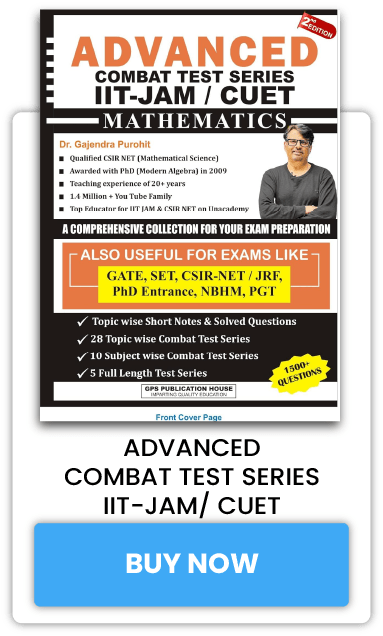
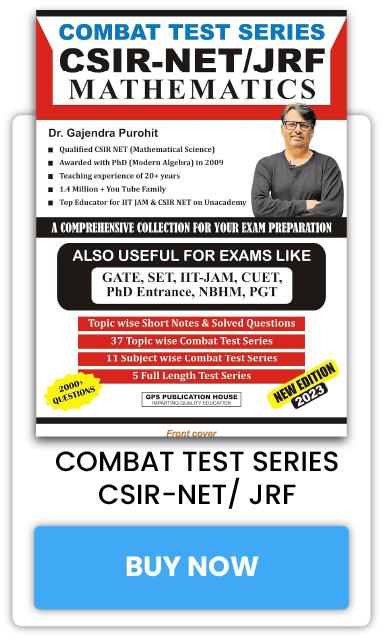
BEST BOOKS FOR IIT JAM/ CSIR-NET
BUY BOOKS ON OUR APP