UPPSC LT Grade Teacher vs GIC Lecturer Comparison
Rajasthan Public Service Commission (RPSC) Grade B: The Uttar Pradesh Public Service Commission (UPPSC) organizes recruitment for both LT Grade Teacher Teachers and GIC Lecturers. Although both positions are prestigious and attract a large number of aspirants every year, they differ significantly in terms of exam pattern, syllabus, career responsibilities, and growth opportunities. Understanding these differences is vital for aspirants to make an informed decision about which exam to target, aligning their preparation strategy with their long-term goals.

UPPSC LT Grade Teacher Exam Pattern
The UPPSC LT Grade Teacher exam is divided into two stages: Prelims and Mains. The Prelims consists of 150 objective questions, out of which 120 are subject-specific and 30 are from General Knowledge. This section tests candidates on their ability to quickly apply conceptual knowledge. Those who qualify proceed to the Mains, which is a descriptive paper containing 20 questions that must be answered within three hours. This stage focuses on the depth of knowledge, writing skills, and analytical clarity. The relatively simpler pattern compared to GIC makes it more accessible to first-time aspirants, but it still requires rigorous preparation.
UPPSC LT Grade Teacher Syllabus
The syllabus for the optional subject in both the Preliminary and Main examinations is the same.
1. Algebra
Theory of equations, A.P., G.P., and H.P.. Sum of squares and cubes of natural numbers. Permutation and combination, binomial theorem, exponential and logarithmic series.
Algebra of sets, relation, and function. Types of relations and functions, equivalence relation, composition of functions, inverse of a function, and binary operations on a set.
Group, subgroup, normal subgroup, quotient group, cyclic group, order of an element in a group, permutation group, even and odd permutations. Lagrange’s theorem and its consequences. Group homomorphism.
Determinants, types of matrices, algebraic operations on matrices, symmetric and skew-symmetric matrices, Hermitian and skew-Hermitian matrices, inverse of a matrix. Rank of a matrix, application of matrix in solving a system of linear equations. Eigenvalues, eigenvectors, Cayley-Hamilton’s theorem and its applications.
2. Real Analysis
Sequence of real numbers, bounded and monotonic sequences, convergent sequences.
Convergence of series of positive terms, comparison test, Cauchy’s nth root test, ratio test, Raabe’s test, logarithmic test.
De Morgan and Bertrand test, alternating series and Leibnitz test.
3. Vector Analysis
Operations with vectors, scalar and vector product of two and three vectors and their applications.
Vector differentiation, gradient, divergence, and curl.
4. Complex Analysis
Complex numbers, functions of a complex variable.
De Moivre’s theorem and its applications, nth roots of unity, exponential, direct and inverse trigonometric, hyperbolic and logarithmic functions of a complex variable.
Continuity and differentiability of complex functions, Cauchy-Riemann equation, analytic functions, and harmonic functions.
5. Calculus
Limit of a function, continuity, and differentiability. Rolle’s theorem, Lagrange’s mean value theorem, L’Hospital rule, and successive differentiation.
Tangent and normal, maxima and minima, increasing and decreasing functions.
Limit, continuity and differentiability of a function of two variables, partial differentiation.
Methods of integration, definite integrals, and application of integration to find the area bounded by curves, length of a curve, surface area, and volumes of solids of revolution.
Solutions of differential equations of the first order and first degree.
6. Geometry
General equation of the second degree and its classification as a pair of straight lines, a circle, a parabola, an ellipse, and a hyperbola. Asymptotes of a hyperbola.
Direction cosines and direction ratios of a line. Cartesian and vector equation of a plane and a line.
Coplanar and skew lines, shortest distance between two lines, and the angle between various geometric elements.
Sphere, cone, and cylinder.
7. Statistics and Probability
Frequency distribution, graphical representation of statistical data, and measures of central tendency (mean, median, and mode) for grouped and ungrouped data.
Theorems on addition and multiplication of probability.
Career Prospects in LT Grade Teacher
Successful candidates in the LT Grade Teacher exam are appointed as teachers in intermediate schools (Classes 9–12). They play a crucial role in laying the academic foundation for students preparing for higher studies. The position provides job stability, government benefits, and promotions based on experience and departmental examinations. While the initial pay is slightly lower than GIC, the LT Grade Teacher post is considered a reliable and respectable government teaching position that offers long-term security.
UPPSC GIC Exam Pattern
The UPPSC GIC Lecturer exam follows a more advanced structure. The Prelims comprises 120 objective questions, of which 80 are subject-related and 40 are from General Knowledge, with each question carrying 2.5 marks. The Mains includes two papers: Paper 1 (Hindi – 100 marks) and Paper 2 (Optional Subject – 300 marks), with 20 descriptive questions in the optional subject paper. This makes the exam more challenging, demanding proficiency in both Hindi and the chosen subject, as well as strong descriptive writing abilities.
UPPSC GIC Syllabus
The syllabus for Mathematics is extensive, covering the following topics:
1. Relation and Functions
Types of relations: reflexive, symmetric, transitive, and equivalence relations.
Equivalence class.
One-one and onto functions.
Composite and inverse of a function.
Binary operation.
2. Algebra
Matrices: Types of matrices, zero matrix, transpose, symmetric and skew-symmetric matrices. Addition, multiplication, and scalar multiplication of matrices. Singular, non-singular, and invertible matrices.
Determinants: Determinants of a square matrix (up to 3×3). Properties of determinants, adjoint and inverse of a square matrix.
Theory of Equations: Theory of equations of degree greater than or equal to two. Arithmetic, Geometric, and Harmonic progressions. Permutations and combinations, binomial theorem. Sum of exponential and logarithmic series.
Probability: Multiplication theorem on probability, conditional probability, independent events, total probability, and Bayes’s theorem distribution.
3. Calculus
Limit of a function: Continuity and differentiability. Derivative of composite functions and differentiation of different types of functions. Chain rule, Rolle’s theorem, and Lagrange’s mean value theorem. Maclaurin’s & Taylor’s series, L’Hospitals rule, partial differentiation, and successive differentiation. Equation of tangent & normal to a given curve. Maxima, minima, and increasing and decreasing functions.
Integration: Various methods of integration, definite integration as a limit of sum. Basic properties of definite integrals. Application in finding the area under simple curves of spheres, cones & cylinders.
Differential Equations: Order and degree of a differential equation. Formation of differential equations whose general solution is given. Solution of differential equations of 1st order & 1st degree. Linear and homogeneous differential equations with constant coefficients.
4. Coordinate Geometry of Two Dimensions
Equation of the pair of straight lines in homogeneous and non-homogeneous form.
Conditions when a non-homogeneous equation of the 2nd degree represents a circle, parabola, ellipse, and hyperbola.
Equation of tangents and normals to conics. Common tangents to two conics, pair of tangents, chord of contacts, and polar lines.
5. Vectors and Three-Dimensional Geometry
Vectors: Vector and scalars, unit vectors, direction cosines/ratios. Multiplication of a vector by a scalar, dot and cross products.
Three-dimensional Geometry: Direction cosines/ratios of a line joining two points. Cartesian and vector equations of a line and a plane. Coplanar and skew lines, shortest distance between two lines.
Equations: Equation of a sphere, cones, and cylinders.
6. Group
Group Theory: Examples of groups, especially the group of nth roots of unity, and residue class modulo n. Subgroups, homomorphisms, isomorphisms, and their properties. Cyclic groups, Symmetric group Sn, Lagrange’s theorem, and Fermat’s theorem.
Ring and Field: Ring and field with simple examples.
Linear Algebra: Vector space with examples, subspace, linear dependence and independence, basis and dimension. Linear transformation, kernel, image, rank, and nullity.
Vector Differentiation: Gradient, divergence, curl, and first-order vector identities. Directional derivatives.
Vector Integration: Line integral, surface integral, volume integral, Green’s theorem, Gauss-divergence theorem, and Stokes’s theorem.
Riemann Integration: Integration of discontinuous functions, lower and upper integrals of a bounded function, step function, and signum function.
Statics: Equilibrium of a body under the action of three forces and coplanar forces. Centre of gravity, common catenary, and friction.
Dynamics: Motion of a projectile, work, power, and energy. Radial and transverse velocity and acceleration.
Trigonometry: Trigonometric equations, properties of triangles, inverse circular functions, complex numbers, and De Moivre’s theorem.
Other Topics: Linear programming, logarithmic differentiation, derivatives of implicit functions, approximation, and application of derivatives. Straight line and its various forms.
Career Prospects in GIC
Candidates selected as GIC Lecturers are appointed in Government Inter Colleges (Male and Female), teaching at the senior secondary level. The post carries a Level-8 pay scale (₹47,600 – ₹1,51,100) with additional allowances like DA, HRA, and medical benefits. The career trajectory is faster, offering promotions and recognition based on seniority and performance. With higher pay, more responsibilities, and advanced teaching roles, GIC Lecturer positions are regarded as more prestigious and competitive than LT Grade Teacher.
UPPSC LT vs UPPSC GIC
Exam Pattern: The LT Grade Teacher exam has one descriptive Mains paper, whereas GIC has two papers in Mains, including Hindi, making it more comprehensive and challenging.
Syllabus Coverage: LT Grade Teacher emphasizes Real and Complex Analysis, while GIC covers advanced areas like Vector Integration, Abstract Algebra, Riemann Integration, and Probability Theorems.
Difficulty Level: LT Grade Teacher is moderately difficult, suitable for those with solid undergraduate-level preparation. GIC, however, is considered tougher due to its broader and deeper syllabus.
Job Posting: LT Grade Teacher teachers are posted in intermediate schools, while GIC lecturers work in Government Inter Colleges, handling more advanced classes.
Salary & Benefits: Both positions offer government job stability, but GIC provides a higher pay scale and additional allowances, making it financially more attractive.
Career Growth: LT Grade Teacher offers steady growth within schools, whereas GIC provides broader opportunities for promotions, recognition, and senior academic roles.
Overall Scope: LT Grade Teacher is ideal for aspirants focusing on foundational teaching, while GIC is better suited for those aspiring to handle advanced subjects and higher responsibilities.
Conclusion
Both UPPSC LT Grade Teacher and UPPSC GIC Lecturer exams are integral to the teaching framework in Uttar Pradesh. LT Grade Teacher offers stability, foundational teaching roles, and accessibility for beginners, while GIC is more prestigious, financially rewarding, and academically challenging. Aspirants should carefully evaluate their strengths, comfort with advanced topics, and long-term career aspirations before choosing which exam to prioritize. Ultimately, both roles are vital for strengthening the state’s education system and shaping the future of students.
RPSC Grade B
RPSC stands for the Rajasthan Public Service Commission. The RPSC is a constitutional body that conducts recruitment exams and advises the state government on recruitment, transfers, disciplinary actions etc.
if candidates are preparing for RPSC, then they also need to study History, Economy, Geography, Polity, and Current Affairs related to Rajasthan state as mentioned in the RAS Syllabus. Read/download the new and updated RAS Exam Pattern.
The RPSC Programmer age limit is 21 to 40 years. Candidates must have a bachelors or masters degree in Information Technology, Computer Science or Electronics & Communication. Candidates must have valid documents to support their claim of fulfilling the RPSC Programmer eligibility criteria.
The RPSC Programmer age limit is 21 to 40 years. Candidates must have a bachelors or masters degree in Information Technology, Computer Science or Electronics & Communication. Candidates must have valid documents to support their claim of fulfilling the RPSC Programmer eligibility criteria.
During the probation period, these Senior Teachers receive Rs 26500 monthly. After completing probation, the starting salary increases to Rs 37800 per month. After gaining experience, teachers can earn up to Rs 119700 monthly.
BEST OFFERING COURSES FOR YOU
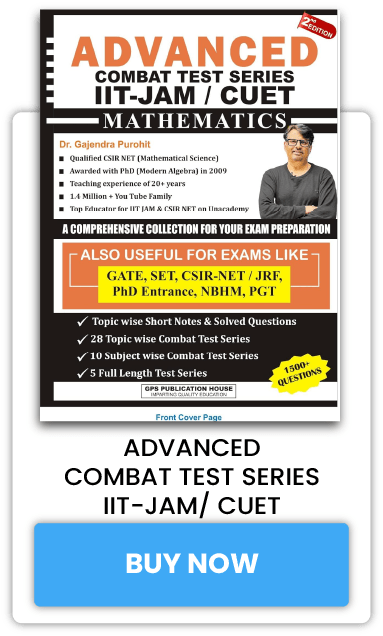
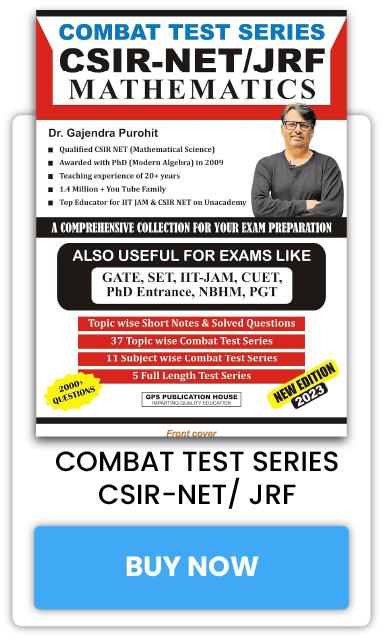
BEST BOOKS FOR IIT JAM/ CSIR-NET
BUY BOOKS ON OUR APP