Integral Equations for CSIR NET and GATE Mathematics: Fredholm, Volterra and Solved Examples
Last updated: 21 November 2026 (IST). Verified against official CSIR HRDG, IIT JAM 2027 (IIT Kharagpur), and GATE 2027 (IIT Madras) Mathematics syllabi.
Integral equations in one paragraph
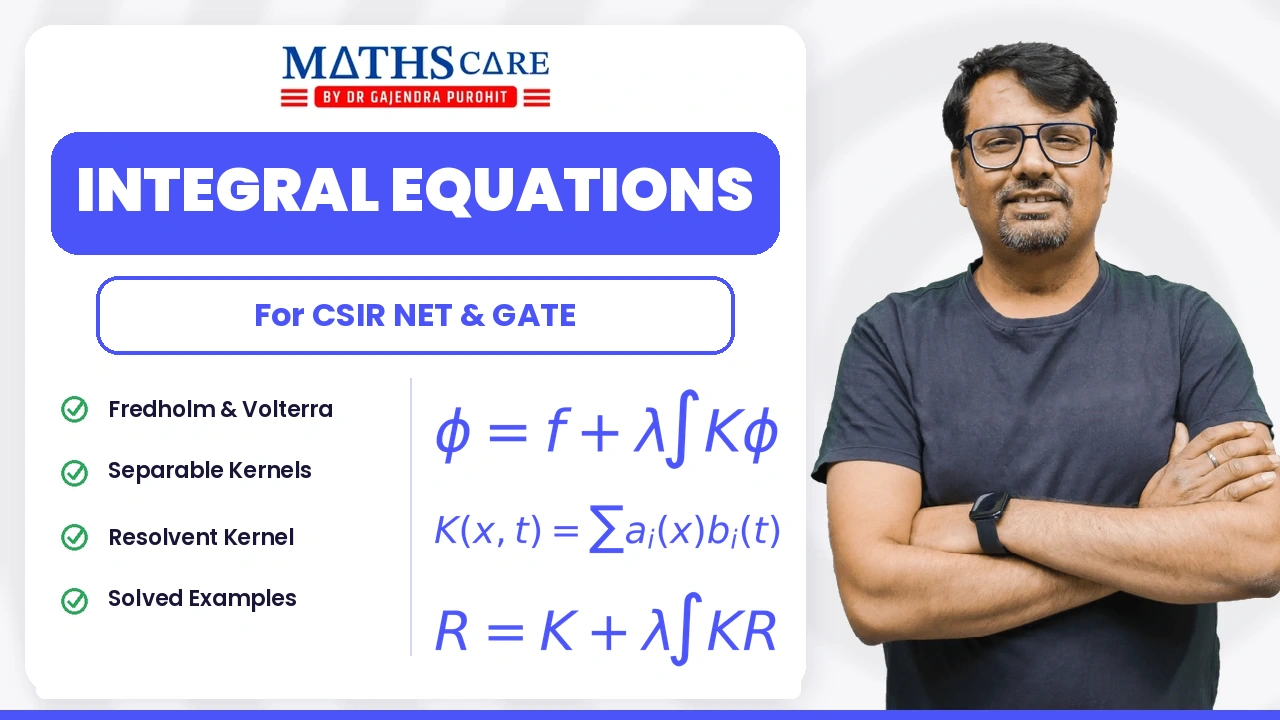
Linear integral equations are a listed topic in Unit 3 of the official CSIR NET Mathematical Sciences syllabus: Fredholm and Volterra equations of the first and second kind, separable kernels, characteristic numbers and eigenfunctions, and the resolvent kernel. They are not a listed section in the official GATE 2027 MA syllabus (IIT Madras, revised for 2027) and they are not on the official IIT JAM 2027 MA syllabus. This post is written for CSIR NET candidates, and for anyone revisiting the standard theory. The scoring core is small and very examinable: classify the equation, reduce a separable Fredholm kernel to a linear algebraic system, find the characteristic values, and know how an initial value problem becomes a Volterra equation. Do that cleanly, and Unit 3 integral equations are a compact, high-yield block.
What each exam’s syllabus says
| Exam | Integral equations in the official syllabus |
|---|---|
| CSIR NET Mathematical Sciences (Unit 3, Linear Integral Equations) | Linear integral equation of the first and second kind of Fredholm and Volterra type; solutions with separable kernels; characteristic numbers and eigenfunctions; resolvent kernel. |
| IIT JAM 2027 Mathematics | Not listed in the official MA syllabus. Do not treat integral equations as a JAM 2027 topic. |
| GATE 2027 Mathematics | Not listed as a section in the official GATE 2027 MA syllabus (IIT Madras). The 2027 syllabi have been revised; candidates sitting only GATE 2027 should follow that PDF and should not assume older topic lists still apply. |
CSIR NET mathematics students answer Unit 3 in addition to compulsory Unit 1. Read this post alongside the ordinary differential equations guide, the partial differential equations guide and the numerical analysis guide. CSIR NET December 2026 Mathematical Sciences is on 27 December 2026, 3:00 PM to 6:00 PM (NTA notice of 20 November 2026). Use the CSIR NET December 2026 timeline tracker for later official notices.
The results you should know without thinking
The four types. A Fredholm equation of the second kind has the shape \(\phi(x)=f(x)+\lambda\int_a^b K(x,t)\phi(t)\,dt\), with a fixed interval \([a,b]\). The same equation with the integral running from \(a\) to \(x\) is Volterra of the second kind. Dropping the standalone \(f\) term and the factor in front of the unknown, or moving the unknown entirely under the integral, produces the corresponding first-kind equations: \(\,f(x)=\lambda\int K\phi\). Second-kind equations are the ones for which a straightforward existence theory (unique solution except at characteristic values) is usually available; first-kind Fredholm equations are more delicate.
Separable (degenerate) kernels. If \(K(x,t)=\sum_{i=1}^n a_i(x)b_i(t)\), a Fredholm equation of the second kind reduces to an \(n\times n\) linear system for the moments \(c_i=\int_a^b b_i(t)\phi(t)\,dt\). Once the \(c_i\) are known, \(\phi\) is written down at once in terms of \(f\) and the \(a_i\). This is the single most useful computational device on the CSIR list, and it is how most Part B questions are meant to be finished.
Characteristic numbers and eigenfunctions. The homogeneous second-kind equation \(\phi=\lambda K\phi\) has a non-trivial solution precisely when \(\lambda\) is a characteristic number (an eigenvalue of the integral operator). The corresponding solutions are the eigenfunctions. For a separable kernel these are the values of \(\lambda\) that make the algebraic system singular. At a characteristic value the inhomogeneous equation either has no solution or infinitely many, according to a solvability condition on \(f\).
The resolvent kernel. When \(\lambda\) is not characteristic, the unique solution of the second-kind Fredholm equation can be written \(\phi(x)=f(x)+\lambda\int_a^b R(x,t;\lambda)f(t)\,dt\). The kernel \(R\) is the resolvent. It satisfies a pair of integral equations of its own, \(R=K+\lambda K*R=K+\lambda R*K\), and for a Volterra kernel the Neumann series \(R=K+\lambda K_2+\lambda^2 K_3+\cdots\) (iterated kernels) converges for every \(\lambda\). That last fact is why Volterra equations of the second kind have no characteristic values in the usual theory.
Conversion to and from differential equations. An initial value problem \(y’=F(x,y)\), \(y(a)=y_0\), is equivalent to the Volterra equation \(y(x)=y_0+\int_a^x F(t,y(t))\,dt\). Differentiating a Volterra or Fredholm equation (Leibniz’s rule) can return you to a differential equation plus initial or boundary conditions, which is often the fastest way to solve a kernel that came from a Green’s function. This is the official link between this topic, the ordinary differential equations guide, and Green’s functions.
Solved examples in exam style
Example 1: from an IVP to a Volterra equation (CSIR NET)
Convert the initial value problem \(y’=x+y\), \(y(0)=1\), into a Volterra integral equation, and verify that the usual exponential solution satisfies it.
Solution. Integrate from \(0\) to \(x\): \(y(x)-y(0)=\int_0^x\bigl(t+y(t)\bigr)\,dt\). With \(y(0)=1\) this is the Volterra equation of the second kind
\[ y(x)=1+\int_0^x t\,dt+\int_0^x y(t)\,dt=1+\frac{x^2}{2}+\int_0^x y(t)\,dt. \]
The ODE has the solution \(y=2e^x-x-1\). Substituting, the right-hand side is \(1+x^2/2+\int_0^x(2e^t-t-1)\,dt=1+x^2/2+[2e^t-t^2/2-t]_0^x=1+x^2/2+2e^x-x^2/2-x-2=2e^x-x-1\), which matches. Differentiation of the integral equation, plus the check \(y(0)=1\), returns the original IVP, so the two problems are equivalent.
Example 2: a separable Fredholm equation (CSIR NET Part B)
Solve \(\phi(x)=x+\lambda\int_0^1 xt\,\phi(t)\,dt\), and determine the values of \(\lambda\) for which a solution exists.
Solution. The kernel \(K(x,t)=xt\) is separable. Factor \(\phi(x)=x+\lambda x\int_0^1 t\phi(t)\,dt=x\bigl(1+\lambda c\bigr)\), where \(c=\int_0^1 t\phi(t)\,dt\). Insert this expression for \(\phi\) into the definition of \(c\):
\[ c=\int_0^1 t\cdot t(1+\lambda c)\,dt=(1+\lambda c)\int_0^1 t^2\,dt=\frac{1+\lambda c}{3}. \]
Hence \(3c=1+\lambda c\), or \(c(3-\lambda)=1\). If \(\lambda\neq 3\), then \(c=1/(3-\lambda)\) and
\[ \phi(x)=x\left(1+\frac{\lambda}{3-\lambda}\right)=\frac{3x}{3-\lambda}. \]
If \(\lambda=3\), the condition \(c(3-\lambda)=1\) becomes \(0=1\), which is impossible. So there is no solution when \(\lambda=3\). (The homogeneous equation, with the \(x\) on the right-hand side removed, does have non-trivial solutions precisely at \(\lambda=3\), namely scalar multiples of \(x\).)
Example 3: characteristic numbers (CSIR NET Part C)
For the kernel \(K(x,t)=xt\) on \([0,1]\), find the characteristic numbers and the corresponding eigenfunctions of the homogeneous equation \(\phi(x)=\lambda\int_0^1 xt\,\phi(t)\,dt\).
Solution. As in Example 2, \(\phi(x)=\lambda x c\) with \(c=\int_0^1 t\phi(t)\,dt\). Then \(c=\lambda c\int_0^1 t^2\,dt=\lambda c/3\). If \(c=0\), then \(\phi=0\). A non-trivial solution needs \(\lambda/3=1\), so \(\lambda=3\), and then \(\phi(x)\) is an arbitrary multiple of \(x\). Thus there is a single characteristic number, \(3\), with eigenfunctions \(\phi(x)=\alpha x\), \(\alpha\neq 0\). This is consistent with Example 2: the inhomogeneous equation fails exactly at this characteristic value.
Example 4: a first-kind versus second-kind trap (CSIR NET)
Let \(K(x,t)=xt\) on \([0,1]\). Does the first-kind equation \(\int_0^1 xt\,\phi(t)\,dt=x\) have a solution? Does every right-hand side \(f(x)\) admit a solution?
Solution. The left-hand side is \(x\int_0^1 t\phi(t)\,dt=cx\), so the equation says \(cx=x\) for all \(x\in[0,1]\), hence \(c=1\). Any \(\phi\) with \(\int_0^1 t\phi(t)\,dt=1\) is a solution; there are infinitely many (for instance \(\phi=3\), or \(\phi=2+t\), and so on). If the right-hand side is not a scalar multiple of \(x\), say \(f(x)=1\), then \(cx=1\) is impossible, and there is no solution. A first-kind Fredholm equation with a separable kernel is severely over-determined: the right-hand side must lie in a finite-dimensional space, and when it does, the solution is highly non-unique. That is why the official syllabus treats first-kind and second-kind equations as distinct, and why a second-kind term \(\phi-f\) is what makes the problem well-posed away from characteristic values.
True-or-false traps from Part C style questions
- “Every Fredholm equation of the second kind has a unique solution for every \(\lambda\).” False: uniqueness (and even existence) fails at characteristic values, as in Example 2.
- “Volterra equations of the second kind have a sequence of characteristic values, just like Fredholm equations.” False: in the standard continuous-kernel theory they have none; the resolvent series converges for every scalar.
- “A separable kernel of rank \(n\) has exactly \(n\) characteristic numbers, counting multiplicity.” Not always in the naïve sense: some of the algebraic eigenvalues can fail to produce a genuine \(L^2\) eigenfunction if the corresponding factors are linearly dependent. Always go back to the integral equation.
- “First-kind and second-kind Fredholm equations with the same kernel have the same solutions.” False: see Example 4. First-kind problems are typically ill-posed.
- “Differentiating a Volterra equation always loses solutions.” If you differentiate you must keep the initial condition obtained by setting the variable endpoint equal to the lower limit; that restores equivalence.
How to prepare integral equations in four weeks
- Week 1 — classification and conversions. Name any given equation as Fredholm or Volterra, first or second kind, and convert two initial value problems into Volterra form and back. This week also revises Leibniz’s rule.
- Week 2 — separable kernels. Work a dozen second-kind Fredholm equations with kernels of rank one and two, including the homogeneous case, until the linear-algebra step is automatic. This is the heart of the CSIR list.
- Week 3 — characteristic values and the resolvent. Compute characteristic numbers, write eigenfunctions, and form the resolvent for at least one separable kernel and one iterated-kernel (Neumann) example, preferably Volterra.
- Week 4 — mixed Unit 3 practice. Sit previous year integral-equation questions from the CSIR NET Mathematics previous year papers, and mix them with ordinary differential equations guide, partial differential equations guide and numerical analysis guide so that a Unit 3 paper does not feel like four separate subjects. Keep the CSIR NET 30-day strategy and the CSIR NET paper pattern in view.
If you are close to the 27 December 2026 CSIR paper, spend almost all of the remaining time on separable second-kind Fredholm equations and on the IVP–Volterra conversion. Do not divert official GATE 2027 preparation time to this topic: it is not on the official 2027 MA syllabus.
GP Sir’s integral equations classes
These lectures are from Dr. Gajendra Purohit’s official channels. Start with the one-shot overview, then the Volterra-to-IVP conversion and a Fredholm solution lecture.
Learn integral equations with MathsCare
Want live classes and Part C practice with GP Sir? Message or call the MathsCare team, or see the CSIR NET Maths course.
GP Sir’s Combat Test Series for CSIR NET/JRF Mathematics is the practice book we point CSIR students to for this unit; the Short Notes Booklet is for last-week revision. Check the book pages for the current edition before you buy.
Integral equations sit next to Green’s functions in the ordinary differential equations guide and next to numerical approximation in the numerical analysis guide. Unit 1 remains compulsory: keep the real analysis guide in rotation.
Frequently asked questions
Is integral equations a topic in the official GATE 2027 Mathematics syllabus?
No. The official GATE 2027 MA syllabus published by IIT Madras (revised for 2027) has eleven sections, and linear integral equations are not among them. Candidates preparing only for GATE 2027 should follow that PDF and should not treat this topic as a listed GATE 2027 section. The title of this post keeps the common CSIR–GATE grouping, but the syllabus fact is the official 2027 list.
Is integral equations in IIT JAM 2027 Mathematics?
No. The official JAM 2027 MA syllabus (IIT Kharagpur) does not list integral equations. JAM candidates can skip this post for the 2027 MA paper.
What does the CSIR NET syllabus actually say?
The official CSIR HRDG Unit 3 syllabus, under Linear Integral Equations, lists linear integral equations of the first and second kind of Fredholm and Volterra type, solutions with separable kernels, characteristic numbers and eigenfunctions, and the resolvent kernel.
What is the difference between a Fredholm equation and a Volterra equation?
In a Fredholm equation the integral is over a fixed interval, independent of the unknown’s argument. In a Volterra equation one limit of integration is the independent variable, so the interval grows with x. A first-kind equation has the unknown only under the integral; a second-kind equation also has a term outside the integral.
How do you convert an initial value problem into a Volterra equation?
Starting from y’=f(x,y) with y(a)=y0, integrate both sides from a to x to obtain y(x)=y0 plus the integral from a to x of f(t,y(t)) dt. That is a Volterra equation of the second kind. The same idea, integrated twice, converts a second-order initial value problem into a Volterra equation.
Can I contact MathsCare about integral equations classes?
Yes. Message or call the MathsCare team on WhatsApp at 95710 85397 for details of the CSIR NET Mathematics course.
Official sources
- CSIR HRDG Mathematical Sciences syllabus (Units 1–3): official syllabus PDF; notices: csirnet.nta.nic.in
- NTA public notice dated 20 November 2026, subject-wise schedule of Joint CSIR-UGC NET December 2026: Mathematical Sciences (code 704) on 27 December 2026, Shift 2, 3:00 PM to 6:00 PM. Download the notice.
- IIT JAM 2027 Mathematics (MA) syllabus, Organising Institute IIT Kharagpur: MA syllabus PDF; website: jam.iitkgp.ac.in. The examination is on 14 February 2027.
- GATE 2027 Mathematics (MA) syllabus, Organising Institute IIT Madras: official MA syllabus PDF; website: gate2027.iitm.ac.in. The GATE 2027 syllabi have been revised; always check this PDF.