Partial Differential Equations for CSIR NET and GATE Mathematics: Classification, Methods and Solved Examples
Last updated: 19 November 2026 (IST). Verified against official CSIR HRDG, IIT JAM 2027 (IIT Kharagpur), and GATE 2027 (IIT Madras) Mathematics syllabi.
Partial differential equations in one paragraph
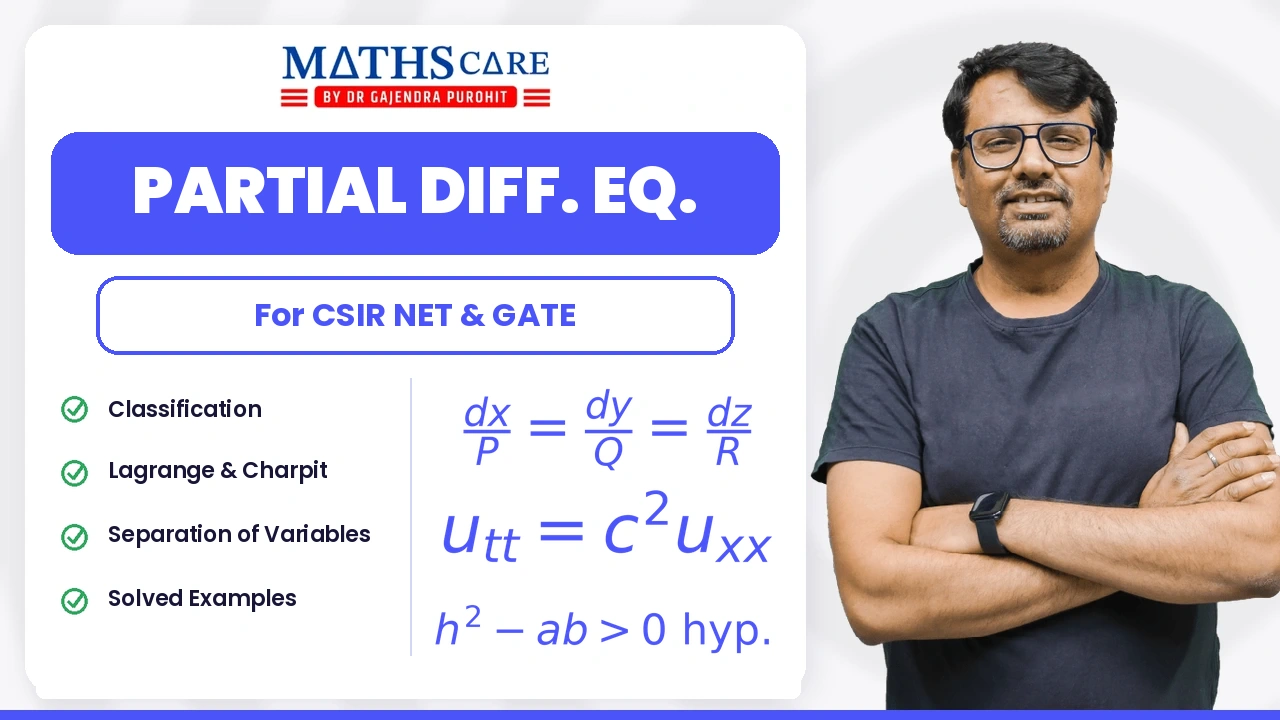
Partial differential equations are a Unit 3 topic for CSIR NET Mathematical Sciences and a full section of GATE 2027 Mathematics. They are not on the official IIT JAM 2027 MA syllabus, so JAM candidates can leave this post aside for the 2027 paper. The questions that appear again and again are first-order equations by Lagrange’s method (and Charpit’s method in CSIR NET), classification of second-order equations by the discriminant, and separation of variables for the Laplace, heat and wave equations. GATE adds canonical forms, the maximum principle, d’Alembert’s formula with domains of dependence, and transform methods. If you can classify an equation in thirty seconds, write a complete Lagrange or characteristic solution, and separate variables cleanly, PDE becomes one of the more predictable scoring units in Unit 3.
What each exam’s syllabus says
| Exam | Partial differential equations in the official syllabus |
|---|---|
| CSIR NET Mathematical Sciences (Unit 3, PDEs) | Lagrange and Charpit methods for solving first-order PDEs, Cauchy problem for first-order PDEs. Classification of second-order PDEs, general solution of higher-order PDEs with constant coefficients, method of separation of variables for Laplace, heat and wave equations. |
| IIT JAM 2027 Mathematics | Not listed. Section 2 of the official MA syllabus is ordinary differential equations only. Do not treat PDE as a JAM 2027 topic. |
| GATE 2027 Mathematics (Section 9) | Method of characteristics for first-order linear and quasilinear partial differential equations. Second-order partial differential equations in two independent variables: classification and canonical forms; method of separation of variables for the Laplace equation in Cartesian and polar coordinates; maximum principle; heat and wave equations in one space variable; wave equation: Cauchy problem and d’Alembert formula, domains of dependence and influence, non-homogeneous wave equation; heat equation: Cauchy problem; Laplace and Fourier transform methods. |
CSIR NET mathematics students answer Unit 3 in addition to the compulsory Unit 1. Pair this post with the ordinary differential equations guide, the integral equations guide and the numerical analysis guide, which share that unit. Official dates: CSIR NET December 2026 Mathematical Sciences is on 27 December 2026, 3:00 PM to 6:00 PM (NTA notice of 20 November 2026). Use the CSIR NET December 2026 timeline tracker for later notices.
The methods you should know without thinking
Lagrange’s linear first-order equation. The equation \(P p+Q q=R\), with \(p=\partial z/\partial x\) and \(q=\partial z/\partial y\), is solved by the auxiliary (characteristic) equations \(dx/P=dy/Q=dz/R\). Two independent integrals \(u(x,y,z)=c_1\) and \(v(x,y,z)=c_2\) give the general solution in the form \(F(u,v)=0\), or equivalently \(v=f(u)\). This is the CSIR NET starting point and is the same idea as the method of characteristics on the GATE list.
Charpit’s method (CSIR NET). For a non-linear first-order equation \(F(x,y,z,p,q)=0\), Charpit’s auxiliary equations produce a second relation involving \(p\) and \(q\). Together with \(F=0\) this determines \(p\) and \(q\), and \(dz=p\,dx+q\,dy\) is then integrated. Standard typable cases (equations missing \(x\) or \(y\), Clairaut type, and equations of the form \(F(p,q)=0\)) are worth memorising as shortcuts, but only after you can run the general method.
Classification. For \(A u_{xx}+2B u_{xy}+C u_{yy}+\cdots=0\), compute \(\Delta=B^2-AC\). The equation is hyperbolic if \(\Delta>0\), parabolic if \(\Delta=0\), and elliptic if \(\Delta<0\). The model examples are the wave equation \(u_{tt}-c^2 u_{xx}=0\) (hyperbolic), the heat equation \(u_t-k u_{xx}=0\) (parabolic), and Laplace’s equation \(u_{xx}+u_{yy}=0\) (elliptic). On the GATE syllabus you are also expected to reduce a second-order equation in two variables to a canonical form by a change of coordinates built from the characteristic curves.
Separation of variables. For the Laplace, heat and wave equations on a rectangle or a finite interval, you assume a product solution, impose the homogeneous boundary conditions to obtain an eigenvalue problem, and expand the remaining initial or boundary data as a Fourier series (or a Fourier–Bessel series in polar coordinates, which GATE lists explicitly for Laplace’s equation). Always write the eigenvalue problem down before you guess the form of the series.
d’Alembert and domains of dependence (GATE). The general solution of \(u_{tt}=c^2 u_{xx}\) on the line is \(u=f(x-ct)+g(x+ct)\). With initial data \(u(x,0)=\phi(x)\) and \(u_t(x,0)=\psi(x)\), d’Alembert’s formula follows at once. The value \(u(x,t)\) depends only on \(\phi\) at the two endpoints of \([x-ct,x+ct]\) and on \(\psi\) along that interval — the domain of dependence. Conversely, the domain of influence of a point \(x_0\) on the initial line is the wedge \(|x-x_0|\le c t\). The maximum principle for Laplace’s (and, in the appropriate form, heat) equation is the elliptic counterpart: a non-constant harmonic function on a bounded domain attains its maximum and minimum on the boundary.
Solved examples in exam style
Example 1: Lagrange’s method (CSIR NET, GATE)
Solve \(x p + y q = z\).
Solution. The auxiliary equations are \(dx/x=dy/y=dz/z\). From the first two ratios, \(dy/y=dx/x\), so \(\ln|y|=\ln|x|+c\), or \(y/x=c_1\). From the first and the third, \(dz/z=dx/x\), so \(z/x=c_2\). The general solution is \(F(y/x,\,z/x)=0\), which can be written \(z=x f(y/x)\) for an arbitrary function \(f\). (This is the statement that the solution is an arbitrary homogeneous function of degree one, or equivalently a cone with vertex at the origin.)
Example 2: classification (CSIR NET, GATE)
Classify \(u_{xx}+2u_{xy}+u_{yy}=0\). Reduce the principal part to a canonical form if you can.
Solution. Here \(A=1\), \(2B=2\) so \(B=1\), and \(C=1\). The discriminant is \(B^2-AC=1-1=0\), so the equation is parabolic at every point. The principal part is a perfect square: \((\partial_x+\partial_y)^2 u=0\). The change of coordinates \(\xi=x\), \(\eta=y-x\) (the repeated characteristic direction is \(dy/dx=1\)) reduces the principal part to a multiple of \(u_{\xi\xi}\), which is the canonical parabolic form. (By contrast, \(u_{tt}-4u_{xx}=0\) has \(A=1\), \(B=0\), \(C=-4\) if \(t\) is treated as the first variable, and \(B^2-AC=4>0\), so it is hyperbolic.)
Example 3: separation of variables for the heat equation (CSIR NET, GATE)
Solve \(u_t=k u_{xx}\) for \(0<x<L\), \(t>0\), with \(u(0,t)=u(L,t)=0\) and \(u(x,0)=\sin(\pi x/L)\).
Solution. Write \(u=X(x)T(t)\). Then \(T’=k\lambda T\) and \(X”=\lambda X\). The boundary conditions force \(X(0)=X(L)=0\), so \(\lambda=-(n\pi/L)^2\) and \(X_n=\sin(n\pi x/L)\) for \(n=1,2,\dots\). The time factors are \(T_n(t)=\exp(-k(n\pi/L)^2 t)\). The general separated series is \(\sum b_n\sin(n\pi x/L)\exp(-k(n\pi/L)^2 t)\). The initial condition is already a single eigenfunction, so \(b_1=1\) and \(b_n=0\) for \(n\neq 1\). The solution is
\[ u(x,t)=\sin\left(\frac{\pi x}{L}\right)\exp\left(-k\frac{\pi^2}{L^2}t\right). \]
No other coefficients are needed. If the initial data had been a general function, you would have computed the Fourier sine coefficients on \((0,L)\).
Example 4: d’Alembert’s formula (GATE)
Solve \(u_{tt}=c^2 u_{xx}\) on \(\mathbb{R}\times(0,\infty)\), with \(u(x,0)=f(x)\) and \(u_t(x,0)=0\), and describe the domain of dependence of the point \((x,t)\).
Solution. d’Alembert’s formula with zero initial velocity reduces to \(u(x,t)=\frac{1}{2}\bigl(f(x-ct)+f(x+ct)\bigr)\). The value at \((x,t)\) uses the initial displacement only at the two points \(x-ct\) and \(x+ct\), and uses none of the initial velocity. The domain of dependence is still the interval \([x-ct,x+ct]\) on the initial line: if the initial displacement (or, in the general case, the initial velocity) is changed only outside that interval, the value at \((x,t)\) is unchanged. This is the precise meaning of finite propagation speed \(c\).
True-or-false traps from Part C style questions
- “Every second-order equation with constant coefficients is hyperbolic.” False: classification is decided by \(B^2-AC\), not by the presence of constant coefficients. Laplace’s equation is elliptic.
- “Lagrange’s method applies unchanged to a non-linear equation \(F(x,y,z,p,q)=0\).” False: that is Charpit’s setting. Lagrange’s method is for the linear (or quasi-linear) equation \(Pp+Qq=R\).
- “The general solution of a first-order PDE contains two arbitrary functions.” False: it contains one arbitrary function of the two characteristic integrals (or an equivalent implicit relation).
- “A harmonic function on a bounded domain can attain its maximum at an interior point even if it is not constant.” False: that is what the maximum principle rules out.
- “The domain of dependence of \((x,t)\) for the wave equation is the single point \(x\).” False: it is the full interval \([x-ct,x+ct]\). Confusing this with the heat equation, which has infinite propagation speed, is a standard trap.
How to prepare PDEs in four weeks
- Week 1 — first-order equations. Lagrange’s method until two independent integrals are automatic. Then Charpit on two or three standard types. GATE students should also write the characteristic equations of a quasilinear equation in divergence-free form.
- Week 2 — classification and canonical forms. Compute \(B^2-AC\) quickly, and reduce one hyperbolic, one parabolic and one elliptic example to canonical form. Learn the three model equations by heart.
- Week 3 — separation of variables. One fully written heat problem, one wave problem and one Laplace problem (Cartesian, and if you are sitting GATE, one polar example). Always start from the eigenvalue problem.
- Week 4 — d’Alembert, the maximum principle, and revision. Derive d’Alembert once from scratch and sketch a domain-of-dependence triangle. Sit mixed Unit 3 practice with the ordinary differential equations guide and the numerical analysis guide. Use the CSIR NET Mathematics previous year papers and keep the CSIR NET 30-day strategy and the CSIR NET paper pattern in view for Part C limits.
CSIR NET December 2026 Mathematical Sciences is on 27 December 2026, 3:00–6:00 PM. If time is short, put Lagrange, classification and one separated heat or wave problem ahead of transform methods. JAM 2027 MA candidates should not spend official-syllabus time here; use the ordinary differential equations guide and the real analysis guide instead.
GP Sir’s PDE classes
These lectures are from Dr. Gajendra Purohit’s official channels. The two recent first-order lectures complement the Unit III combat class, which mixes PDE with the rest of CSIR Unit 3.
Learn partial differential equations with MathsCare
Want live classes and Part C practice with GP Sir? Message or call the MathsCare team, or see the CSIR NET Maths course. GATE aspirants can use the GATE Maths course.
For mixed Unit 3 practice, use GP Sir’s Combat Test Series for CSIR NET/JRF Mathematics and the Short Notes Booklet for last-week revision. Check the book pages for the current edition before you buy.
PDE sits naturally next to ordinary differential equations guide and to the complex analysis guide when conformal maps are used for plane Laplace problems. Keep Unit 1 sharp as well: the real analysis guide is compulsory in CSIR NET.
Frequently asked questions
Is PDE in the IIT JAM 2027 Mathematics syllabus?
No. The official JAM 2027 MA syllabus (IIT Kharagpur) lists Differential Equations in Section 2, but the items there are ordinary: Bernoulli, exact equations, integrating factors, orthogonal trajectories, homogeneous equations, separation of variables, second-order linear equations with constant coefficients, variation of parameters and the Cauchy–Euler equation. Partial differential equations are not listed. JAM candidates can skip this post for the 2027 MA paper.
What PDE is in the CSIR NET syllabus?
The official CSIR HRDG Unit 3 syllabus lists Lagrange and Charpit methods for first-order PDEs, the Cauchy problem for first-order PDEs, classification of second-order PDEs, the general solution of higher-order PDEs with constant coefficients, and the method of separation of variables for the Laplace, heat and wave equations.
What extra PDE topics are in GATE 2027?
The official GATE 2027 MA syllabus (IIT Madras, Section 9) lists the method of characteristics for first-order linear and quasilinear PDEs; classification and canonical forms of second-order PDEs in two independent variables; separation of variables for the Laplace equation in Cartesian and polar coordinates and the maximum principle; the heat and wave equations in one space variable; the Cauchy problem and d’Alembert formula for the wave equation, with domains of dependence and influence, and the non-homogeneous wave equation; the Cauchy problem for the heat equation; and Laplace and Fourier transform methods.
How do you classify a second-order PDE in two variables?
Write the principal part as A u_xx + 2B u_xy + C u_yy. The discriminant is B squared minus A C. The equation is hyperbolic where the discriminant is positive, parabolic where it is zero, and elliptic where it is negative. The wave, heat and Laplace equations are the three model cases.
What is d’Alembert’s formula?
For the one-dimensional wave equation u_tt = c squared u_xx on the whole line, with u(x,0)=f(x) and u_t(x,0)=g(x), the solution is u(x,t) = [f(x-ct)+f(x+ct)]/2 + (1/(2c)) times the integral of g from x-ct to x+ct. The value at (x,t) depends only on the initial data on the interval [x-ct, x+ct].
Can I contact MathsCare about PDE classes?
Yes. Message or call the MathsCare team on WhatsApp at 95710 85397 for details of the CSIR NET and GATE Mathematics courses.
Official sources
- CSIR HRDG Mathematical Sciences syllabus (Units 1–3): official syllabus PDF; notices: csirnet.nta.nic.in
- NTA public notice dated 20 November 2026, subject-wise schedule of Joint CSIR-UGC NET December 2026: Mathematical Sciences (code 704) on 27 December 2026, Shift 2, 3:00 PM to 6:00 PM. Download the notice.
- IIT JAM 2027 Mathematics (MA) syllabus, Organising Institute IIT Kharagpur: MA syllabus PDF; website: jam.iitkgp.ac.in. The examination is on 14 February 2027.
- GATE 2027 Mathematics (MA) syllabus, Organising Institute IIT Madras: official MA syllabus PDF; website: gate2027.iitm.ac.in. The GATE 2027 syllabi have been revised; always check this PDF.