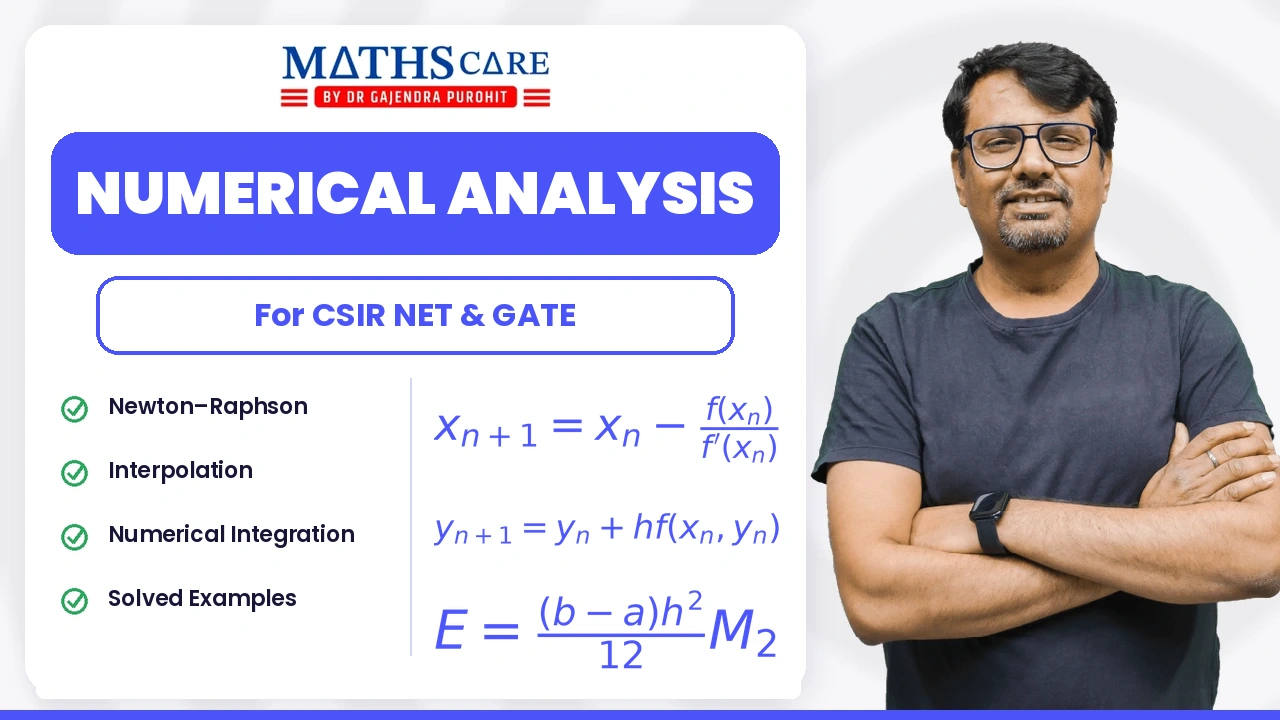
Numerical Analysis for CSIR NET and GATE Mathematics: Methods, Error Bounds and Solved Examples
Last updated: 23 November 2026 (IST). Verified against official CSIR HRDG, IIT JAM 2027 (IIT Kharagpur), and GATE 2027 (IIT Madras) Mathematics syllabi.
Numerical analysis in one paragraph
Numerical analysis is a Unit 3 topic in CSIR NET Mathematical Sciences and Section 8 of GATE 2027 Mathematics. It is not on the official IIT JAM 2027 MA syllabus. The examinable core is small and very concrete: one step (or two) of Newton–Raphson, with the rate of convergence; one linear system by Gauss elimination or Gauss–Seidel, with a diagonal-dominance check; one interpolation formula and its error term; a trapezoidal or Simpson estimate with the official error bound; and one step of Euler or a second-order Runge–Kutta method. If you can produce the next iterate and a correct error bound, this unit is a reliable source of marks. Do not invent “typical weightage” figures — the official documents do not publish a unit-wise mark share for these methods.
What each exam’s syllabus says
| Exam | Numerical analysis in the official syllabus |
|---|---|
| CSIR NET Mathematical Sciences (Unit 3, Numerical Analysis) | Numerical solutions of algebraic equations, method of iteration and Newton–Raphson method, rate of convergence; solution of systems of linear algebraic equations using Gauss elimination and Gauss–Seidel methods; finite differences; Lagrange, Hermite and spline interpolation; numerical differentiation and integration; numerical solutions of ODEs using Picard, Euler, modified Euler and Runge–Kutta methods. |
| IIT JAM 2027 Mathematics | Not listed in the official MA syllabus. Do not treat numerical analysis as a JAM 2027 topic. |
| GATE 2027 Mathematics (Section 8) | Systems of linear equations: direct methods (Gaussian elimination, LU decomposition, Cholesky factorisation); iterative methods (Gauss–Seidel and Jacobi) and their convergence for diagonally dominant coefficient matrices. Numerical solutions of nonlinear equations: bisection method, secant method, Newton–Raphson method, fixed-point iteration. Interpolation: Lagrange and Newton forms of the interpolating polynomial, error in polynomial interpolation of a function. Numerical differentiation and error. Numerical integration: trapezoidal and Simpson rules, Newton–Cotes integration formulae, composite rules, mathematical errors involved in numerical integration formulae. Numerical solution of initial value problems for ordinary differential equations: methods of Euler, Runge–Kutta method of order 2. |
Read this post with the ordinary differential equations guide (the same initial value problems are being discretised) and, for CSIR candidates, with the rest of Unit 3: the partial differential equations guide and the integral equations guide. CSIR NET December 2026 Mathematical Sciences is on 27 December 2026, 3:00 PM to 6:00 PM (NTA notice of 20 November 2026). Use the CSIR NET December 2026 timeline tracker for later notices.
The methods you should know without thinking
Nonlinear equations. Fixed-point iteration \(x_{n+1}=g(x_n)\) converges locally if \(|g'(x_*)|<1\) at a fixed point \(x_*\). The rate is linear, with asymptotic constant \(|g'(x_*)|\). Newton–Raphson is the special case \(g(x)=x-f(x)/f'(x)\), and the rate is quadratic at a simple root: the error is roughly squared at each step once you are close enough. The secant method replaces \(f’\) by a difference quotient and is of order the golden ratio, about \(1.618\). Bisection is slower but globally safe on an interval where \(f\) changes sign and is continuous.
Linear systems. Gauss elimination (with partial pivoting in any serious computation) is the standard direct method; LU and, for a positive definite symmetric matrix, Cholesky are the factorised forms on the GATE 2027 list. Jacobi and Gauss–Seidel are the iterative methods on that list, and the official GATE wording ties a convergence guarantee to a diagonally dominant coefficient matrix. In Gauss–Seidel, each new component is used as soon as it is computed; in Jacobi, a full old vector is held until the sweep is finished. Gauss–Seidel is usually the faster of the two on the same matrix, but that is a rule of thumb, not a theorem you should quote without hypotheses.
Interpolation and its error. The unique polynomial of degree at most \(n\) that meets \(n+1\) distinct nodes can be written in Lagrange form or in Newton divided-difference form. The interpolation error at \(x\) is \(f[x_0,\dots,x_n,x]\,\omega(x)=\frac{f^{(n+1)}(\xi)}{(n+1)!}\omega(x)\) for some \(\xi\), where \(\omega(x)=\prod(x-x_i)\). This formula is the one GATE names explicitly. CSIR also lists Hermite interpolation (matching derivatives as well as values) and splines. Finite differences are the equally spaced special case of Newton’s form.
Numerical integration and differentiation. The (composite) trapezoidal rule has error \(-\frac{(b-a)h^2}{12}f”(\xi)\). Simpson’s rule has error \(-\frac{(b-a)h^4}{180}f^{(4)}(\xi)\). These are the error bounds you should be able to quote and use. Newton–Cotes formulae are the general family of interpolatory rules on equally spaced nodes; trapezoidal and Simpson are the first two usable members. Numerical differentiation by a forward or central difference comes with an explicit leading error term in \(h\), plus the usual warning that a very small \(h\) invites cancellation.
ODE steps. Euler’s method \(y_{n+1}=y_n+h f(x_n,y_n)\) is first-order: the global error is \(O(h)\). The modified Euler method (CSIR) and the Runge–Kutta method of order 2 (both lists; GATE names order 2 specifically) are second-order, with global error \(O(h^2)\). Picard iteration is the integral-equation approach to the same IVP, and it is the theoretical companion of the existence theorem in the ordinary differential equations guide. Do not claim a higher order for a method than the official name allows: “Runge–Kutta” on the GATE 2027 list means the order-2 method unless a paper says otherwise.
Solved examples in exam style
Example 1: two Newton–Raphson steps and the rate (CSIR NET, GATE)
Let \(f(x)=x^3-x-1\). Starting from \(x_0=1\), compute two Newton–Raphson iterates, and state the conditions under which the convergence is quadratic.
Solution. Here \(f'(x)=3x^2-1\). We have \(f(1)=-1\) and \(f'(1)=2\), so
\[ x_1=x_0-\frac{f(x_0)}{f'(x_0)}=1-\frac{-1}{2}=\frac{3}{2}. \]
Then \(f(3/2)=(27/8)-(3/2)-1=7/8\) and \(f'(3/2)=3\cdot(9/4)-1=23/4\), so
\[ x_2=\frac{3}{2}-\frac{7/8}{23/4}=\frac{3}{2}-\frac{7}{8}\cdot\frac{4}{23}=\frac{3}{2}-\frac{7}{46}=\frac{69-7}{46}=\frac{62}{46}=\frac{31}{23}. \]
Numerically, \(x_2\approx 1.3478\). (The unique real root lies in \((1,2)\), since \(f(1)=-1<0<f(2)\).) Quadratic convergence holds once the iterates are close to the root, because \(f\) is \(C^2\) and \(f’\) is non-zero at a simple root. If the root were multiple, the observed order would drop to one.
Example 2: Gauss–Seidel and diagonal dominance (CSIR NET, GATE)
Apply one Gauss–Seidel iteration, starting from \((0,0)\), to the system \(3x+y=5\), \(x+2y=5\). Is the coefficient matrix strictly diagonally dominant?
Solution. The first equation gives \(x=(5-y)/3\). Starting from \(y_0=0\), \(x_1=5/3\). The second equation gives \(y=(5-x)/2\), so \(y_1=(5-5/3)/2=(10/3)/2=5/3\). One Gauss–Seidel step produces \((5/3,\,5/3)\). (The exact solution is \(x=1\), \(y=2\); later sweeps move the iterate towards that point.) The coefficient matrix is \(\begin{pmatrix}3&1\\1&2\end{pmatrix}\). Strict diagonal dominance requires \(|a_{ii}|>\sum_{j\neq i}|a_{ij}|\) in every row: \(3>1\) and \(2>1\), so yes. The GATE 2027 syllabus names this as a sufficient condition for convergence of Gauss–Seidel (and of Jacobi). Sufficiency is not necessity, and a Part C statement that drops the word “strictly” or “sufficient” is the usual trap.
Example 3: Lagrange interpolation error (GATE, CSIR NET)
Let \(f(x)=e^x\). Let \(P\) be the linear polynomial that interpolates \(f\) at \(0\) and \(1\). Give a bound for \(|f(x)-P(x)|\) on \([0,1]\).
Solution. For interpolation at two nodes, the error formula is \(f(x)-P(x)=\frac{f”(\xi_x)}{2}x(x-1)\) for some \(\xi_x\) between the nodes and \(x\). Here \(f”=e^x\), so on \([0,1]\) one has \(1\le f”(\xi)\le e\). Also, for \(x\in[0,1]\), \(|x(x-1)|=x(1-x)\le 1/4\), with equality at \(x=1/2\). Therefore
\[ |f(x)-P(x)|\le \frac{e}{2}\cdot\frac{1}{4}=\frac{e}{8}\qquad\text{for all }x\in[0,1]. \]
The bound is sharp in its ingredients (the maximum of \(|\omega(x)|\) is attained, and \(e^x\) really does reach \(e\)), though the \(\xi_x\) that appears at \(x=1/2\) need not be \(1\). This is the error the official GATE 2027 syllabus is pointing at when it lists “error in polynomial interpolation of a function”.
Example 4: trapezoidal error and an Euler step (CSIR NET, GATE)
(a) The composite trapezoidal rule is used on \([0,1]\) with \(h=1/n\) to approximate \(\int_0^1 e^x\,dx\). Give an upper bound for the absolute error. (b) Take one Euler step of size \(h=0.1\) for \(y’=y\), \(y(0)=1\), and compare it with the exact value \(e^{0.1}\).
Solution. (a) The error formula is \(-\frac{(b-a)h^2}{12}f”(\xi)\) for some \(\xi\in[0,1]\). Here \(b-a=1\) and \(f”=e^x\), so the absolute error is at most \(h^2 e/12=e/(12n^2)\). (b) Euler’s method gives \(y_1=y_0+h f(0,y_0)=1+0.1\cdot 1=1.1\). The exact value is \(e^{0.1}\). A useful comparison (without inventing a numerical table) is the Taylor expansion \(e^{0.1}=1+0.1+(0.1)^2/2+\cdots=1.1+0.005+\cdots\), so the local Euler error is about \(0.005\), consistent with a local truncation of \(O(h^2)\) and a global error of \(O(h)\) over a fixed interval. A second-order Runge–Kutta (or modified Euler) step would pick up that \(h^2/2\) term and raise the global order to two.
True-or-false traps from Part C style questions
- “Newton–Raphson always converges quadratically from any starting point.” False: the theorem is local, and a multiple root reduces the order to one. A bad starting guess can diverge or cycle.
- “Diagonal dominance is necessary and sufficient for Gauss–Seidel to converge.” False: the official GATE wording gives a sufficient condition. Necessity fails.
- “The interpolating polynomial of degree at most \(n\) through \(n+1\) nodes is not unique.” False: it is unique. What is not unique is the form (Lagrange versus Newton) in which you write it.
- “Simpson’s rule is always more accurate than the trapezoidal rule, regardless of \(h\) and of \(f\).” False: the error terms involve different derivatives. For a cubic, Simpson is exact and trapezoidal is not; for a function with a large fourth derivative and a modest second derivative the comparison can go the other way at a particular \(h\). Quote the error formula rather than a slogan.
- “Euler’s method and a second-order Runge–Kutta method have the same global order.” False: Euler is first-order; the GATE 2027 RK method of order 2 is second-order.
How to prepare numerical analysis in four weeks
- Week 1 — nonlinear equations and rates. Bisection, fixed-point iteration with the \(|g’|<1\) test, Newton–Raphson, and (for GATE) the secant method. Compute two iterates by hand and state the order of convergence every time.
- Week 2 — linear systems. One Gauss elimination (and, for GATE, one LU or Cholesky factorisation) and two Gauss–Seidel or Jacobi sweeps, always checking diagonal dominance first.
- Week 3 — interpolation and quadrature. Lagrange and Newton forms, the error formula, trapezoidal and Simpson with their official error bounds. CSIR students add Hermite or a brief spline remark. Write one numerical-differentiation error term.
- Week 4 — ODE steppers and mixed practice. One Euler step, one modified Euler or RK2 step, and (for CSIR) one Picard iterate. Then sit mixed questions from the CSIR NET Mathematics previous year papers with the ordinary differential equations guide. Keep the CSIR NET 30-day strategy and the CSIR NET paper pattern in view. Unit 3 in CSIR NET also contains the partial differential equations guide and the integral equations guide; do not revise numerical analysis in isolation.
If you are close to the 27 December 2026 CSIR paper, prioritise Newton–Raphson, Gauss–Seidel, Lagrange interpolation and one Euler or RK step. JAM 2027 MA candidates should not spend official-syllabus time here.
GP Sir’s numerical analysis classes
These lectures are from Dr. Gajendra Purohit’s official channels. Start with the overview, then Newton–Raphson, and use the Unit III combat class for mixed practice with the rest of CSIR Unit 3.
Learn numerical analysis with MathsCare
Want live classes and exam-style practice with GP Sir? Message or call the MathsCare team, or see the CSIR NET Maths course. GATE aspirants can use the GATE Maths course.
GP Sir’s Combat Test Series for CSIR NET/JRF Mathematics and the Short Notes Booklet are the practice and revision books we point students to. Check the book pages for the current edition before you buy.
Numerical ODE methods sit on top of the theory in the ordinary differential equations guide. Unit 1 remains compulsory for CSIR NET: keep the real analysis guide and the linear algebra guide in rotation.
Frequently asked questions
Is numerical analysis in the IIT JAM 2027 Mathematics syllabus?
No. The official JAM 2027 MA syllabus (IIT Kharagpur) does not list numerical analysis as a section. JAM candidates can skip this post for the 2027 MA paper.
What numerical analysis is in CSIR NET?
The official CSIR HRDG Unit 3 syllabus lists numerical solutions of algebraic equations, the method of iteration and the Newton–Raphson method, rate of convergence, solution of systems of linear algebraic equations using Gauss elimination and Gauss–Seidel, finite differences, Lagrange, Hermite and spline interpolation, numerical differentiation and integration, and numerical solutions of ODEs using Picard, Euler, modified Euler and Runge–Kutta methods.
How does the GATE 2027 list differ from CSIR NET?
The official GATE 2027 MA syllabus (IIT Madras, Section 8) lists: direct methods for linear systems (Gaussian elimination, LU decomposition, Cholesky factorisation); iterative methods (Gauss–Seidel and Jacobi) and their convergence for diagonally dominant coefficient matrices; nonlinear equations (bisection, secant, Newton–Raphson, fixed-point iteration); interpolation (Lagrange and Newton forms, and the interpolation error); numerical differentiation and its error; numerical integration (trapezoidal and Simpson rules, Newton–Cotes formulae, composite rules, and the mathematical errors); and numerical solution of ODE initial value problems by Euler’s method and the Runge–Kutta method of order 2. Hermite and spline interpolation, Picard iteration, and modified Euler, which appear on the CSIR list, are not named on the GATE 2027 list. Cholesky, LU, Jacobi, bisection, the secant method and the explicit Newton interpolation form are GATE items you should not skip.
When does Newton–Raphson converge quadratically?
If f is twice continuously differentiable, f(root)=0 and f'(root) is not zero, then Newton–Raphson converges quadratically once the iterate is close enough to the root. A simple root is essential: a multiple root drops the order of convergence to one, unless the iteration is modified.
Is diagonal dominance necessary for Gauss–Seidel to converge?
Strict diagonal dominance is a standard sufficient condition (it also gives convergence of Jacobi). It is not necessary: there are matrices that fail diagonal dominance and still yield a convergent iteration, and matrices that fail it and do not. In an exam, the safe sufficient test is the one on the GATE 2027 syllabus: diagonal dominance.
Can I contact MathsCare about numerical analysis classes?
Yes. Message or call the MathsCare team on WhatsApp at 95710 85397 for details of the CSIR NET and GATE Mathematics courses.
Official sources
- CSIR HRDG Mathematical Sciences syllabus (Units 1–3): official syllabus PDF; notices: csirnet.nta.nic.in
- NTA public notice dated 20 November 2026, subject-wise schedule of Joint CSIR-UGC NET December 2026: Mathematical Sciences (code 704) on 27 December 2026, Shift 2, 3:00 PM to 6:00 PM. Download the notice.
- IIT JAM 2027 Mathematics (MA) syllabus, Organising Institute IIT Kharagpur: MA syllabus PDF; website: jam.iitkgp.ac.in. The examination is on 14 February 2027.
- GATE 2027 Mathematics (MA) syllabus, Organising Institute IIT Madras: official MA syllabus PDF; website: gate2027.iitm.ac.in. The GATE 2027 syllabi have been revised; always check this PDF.