Ordinary Differential Equations for CSIR NET, IIT JAM and GATE Mathematics: Syllabus, Methods and Solved Examples
Last updated: 17 November 2026 (IST). Verified against official CSIR HRDG, IIT JAM 2027 (IIT Kharagpur), and GATE 2027 (IIT Madras) Mathematics syllabi.
Ordinary differential equations in one paragraph
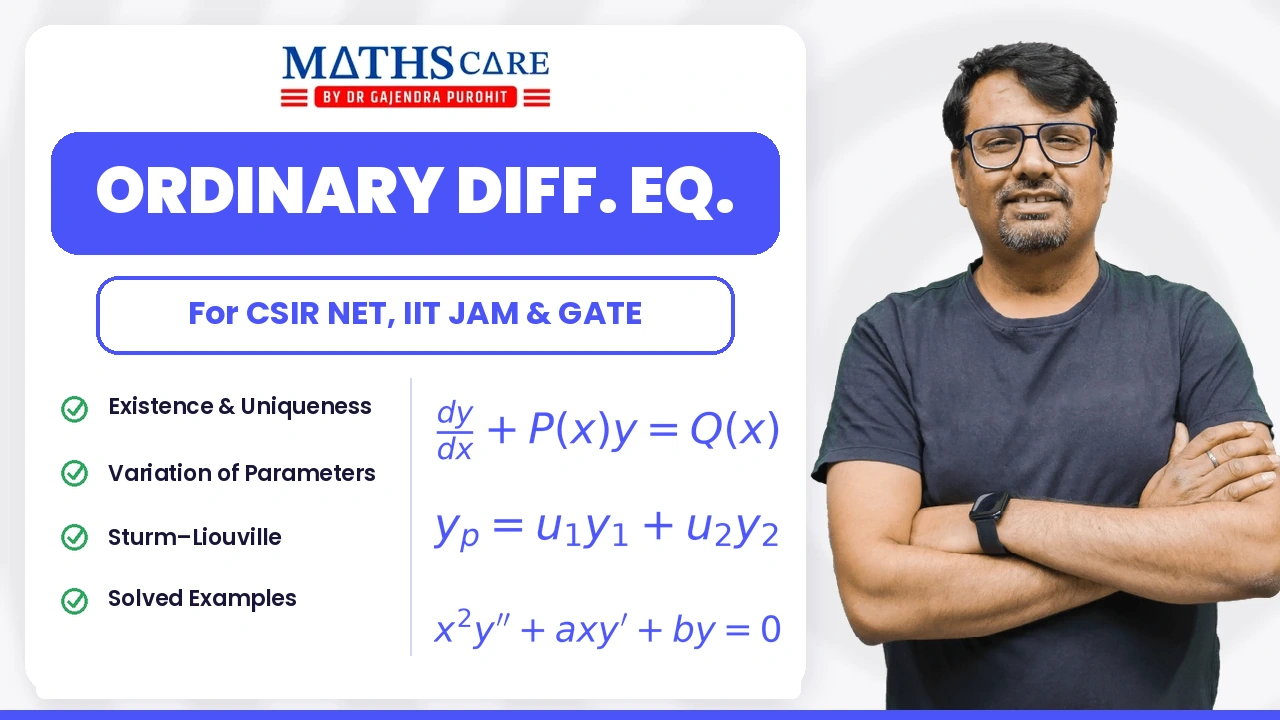
Ordinary differential equations appear in all three exams MathsCare students take, but the official lists are not the same. In IIT JAM 2027 Mathematics ODE is a block of Section 2, built around first-order methods and second-order linear equations with constant coefficients, variation of parameters and the Cauchy–Euler equation. In CSIR NET Mathematical Sciences it is part of Unit 3, and the syllabus adds existence and uniqueness, singular solutions, systems, Sturm–Liouville problems and Green’s functions. In GATE 2027 Mathematics ODE is a full section, with Laplace transforms, Frobenius series, Legendre and Bessel functions, and the stability of planar autonomous systems. First learn the JAM core so that the computational questions are automatic, then add the existence, Sturm–Liouville and (for GATE) series and stability theory that CSIR and GATE actually ask.
What each exam’s syllabus says
| Exam | Ordinary differential equations in the official syllabus |
|---|---|
| CSIR NET Mathematical Sciences (Unit 3, ODEs) | Existence and uniqueness of solutions of initial value problems for first-order ordinary differential equations, singular solutions of first-order ODEs, system of first-order ODEs. General theory of homogeneous and non-homogeneous linear ODEs, variation of parameters, Sturm–Liouville boundary value problem, Green’s function. |
| IIT JAM 2027 Mathematics (Section 2, Differential Equations) | Bernoulli’s equation, exact differential equations, integrating factors, orthogonal trajectories, homogeneous differential equations, method of separation of variables, linear differential equations of second order with constant coefficients, method of variation of parameters, Cauchy–Euler equation. |
| GATE 2027 Mathematics (Section 5) | First-order ordinary differential equations, existence and uniqueness theorems for initial value problems; linear ordinary differential equations of higher order with constant coefficients; second-order linear ordinary differential equations with variable coefficients; Cauchy–Euler equation; definition and basic properties of Laplace transforms, applications of Laplace transforms for solving ordinary differential equations; series solutions (power series, Frobenius method); Legendre and Bessel functions and their orthogonal properties; systems of linear first-order ordinary differential equations; Sturm’s oscillation and separation theorems, Sturm–Liouville eigenvalue problems; planar autonomous systems of ordinary differential equations: stability of stationary points for linear systems with constant coefficients, linearised stability, Lyapunov functions. |
JAM candidates can skip existence and uniqueness proofs, Green’s functions, Sturm–Liouville theory, Laplace transforms, Frobenius series and Lyapunov stability, none of which appear on the official JAM 2027 MA list. CSIR NET mathematics candidates must treat Unit 3 ODE as part of the mathematics stream (the official syllabus says mathematics students answer additional questions from Units 2 and 3). GATE candidates should keep the extra Section 5 items, especially Laplace transforms and series solutions, in regular rotation. Linear algebra is the natural partner of systems of ODEs; see our linear algebra guide.
CSIR NET December 2026 Mathematical Sciences is on 27 December 2026, 3:00 PM to 6:00 PM (NTA notice of 20 November 2026). IIT JAM 2027 is on 14 February 2027. Use the CSIR NET December 2026 timeline tracker and the IIT JAM 2027 exam date and official timeline for official dates only.
The methods you should know without thinking
First-order structure. A first-order equation \(M(x,y)\,dx+N(x,y)\,dy=0\) is exact when \(\partial M/\partial y=\partial N/\partial x\) (on a simply connected domain). If it is not exact, an integrating factor depending only on \(x\) exists when \((M_y-N_x)/N\) is a function of \(x\) alone; an integrating factor depending only on \(y\) exists when \((N_x-M_y)/M\) is a function of \(y\) alone. Homogeneous equations of degree zero reduce by \(y=vx\). Bernoulli’s equation \(y’+P(x)y=Q(x)y^n\), for \(n\neq 0,1\), becomes linear after \(z=y^{1-n}\).
Linear equations. For \(y’+P(x)y=Q(x)\) the integrating factor is \(\exp\int P\,dx\). For an \(n\)th-order linear equation with constant coefficients, the characteristic polynomial decides the complementary function: distinct roots give exponentials, a repeated root of multiplicity \(m\) is multiplied by \(1,x,\dots,x^{m-1}\), and a complex conjugate pair \(\alpha\pm i\beta\) gives \(e^{\alpha x}\cos\beta x\) and \(e^{\alpha x}\sin\beta x\). The Cauchy–Euler equation \(ax^2 y”+bxy’+cy=0\) is reduced by the trial \(y=x^m\) (for \(x>0\)), or by \(x=e^t\).
Variation of parameters. If \(y_1,y_2\) are a fundamental set for the second-order homogeneous equation, a particular solution of \(y”+p y’+q y=g\) is \(y_p=u_1 y_1+u_2 y_2\), where \(u_1′ y_1+u_2′ y_2=0\) and \(u_1′ y_1’+u_2′ y_2’=g\). In Wronskian form, \(u_1’=-y_2 g/W\) and \(u_2’=y_1 g/W\), with \(W=y_1 y_2′-y_2 y_1’\). This method is on all three official syllabi.
Existence and uniqueness (CSIR NET and GATE). Picard–Lindelöf: if \(f\) and \(\partial f/\partial y\) are continuous in a rectangle about \((x_0,y_0)\), there is a unique local solution of \(y’=f(x,y)\), \(y(x_0)=y_0\). Continuity of \(f\) alone gives existence (Peano) but not uniqueness. Singular solutions of a first-order equation, when they exist, are often envelopes of the general family and must be checked against the original equation.
Sturm–Liouville and Green’s functions (CSIR NET and GATE). A regular Sturm–Liouville problem on a compact interval has real eigenvalues, a countable increasing sequence of them, and an orthogonal family of eigenfunctions that is complete in the associated weighted \(L^2\) space. The Green’s function of a linear boundary value problem inverts the differential operator subject to the boundary conditions: the solution is an integral against \(G(x,t)\) of the forcing term. GATE also asks for Sturm’s oscillation and separation theorems, and for the stability of equilibria of planar autonomous systems (eigenvalues of the linearisation; Lyapunov functions).
Solved examples in exam style
Example 1: an exact equation (JAM, CSIR NET)
Solve \((2x+y)\,dx+(x+2y)\,dy=0\).
Solution. Here \(M=2x+y\) and \(N=x+2y\). Then \(M_y=1=N_x\), so the equation is exact. A first integral \(F\) satisfies \(F_x=M\), hence \(F=x^2+xy+g(y)\). Differentiating in \(y\), \(F_y=x+g'(y)=N=x+2y\), so \(g'(y)=2y\) and \(g=y^2\) (up to a constant). The general solution is \(x^2+xy+y^2=C\). (You can complete the square if you wish: \((2x+y)^2+3y^2=4C\), but the implicit form is enough.)
Example 2: variation of parameters (all three exams)
Solve \(y”+y=\sec x\) on an interval where \(\cos x\neq 0\), for instance \((-\pi/2,\pi/2)\).
Solution. The homogeneous equation \(y”+y=0\) has the fundamental set \(y_1=\cos x\), \(y_2=\sin x\), with Wronskian \(W=1\). Variation of parameters gives \(u_1’=-y_2\sec x=-\sin x/\cos x=-\tan x\) and \(u_2’=y_1\sec x=1\). So \(u_1=\ln|\cos x|\) and \(u_2=x\), up to constants that can be absorbed into the complementary function. A particular solution is \(y_p=\cos x\ln|\cos x|+x\sin x\). The general solution is
\[ y=c_1\cos x+c_2\sin x+\cos x\ln|\cos x|+x\sin x. \]
Example 3: failure of uniqueness (CSIR NET, GATE)
Consider \(y’=3y^{2/3}\), \(y(0)=0\). Show that \(f(y)=3y^{2/3}\) is continuous everywhere, that \(\partial f/\partial y\) is unbounded at \(y=0\), and that the initial value problem has more than one solution.
Solution. Continuity of \(f\) on \(\mathbb{R}\) is clear. The formal derivative is \(f'(y)=2 y^{-1/3}\) for \(y\neq 0\), which is unbounded as \(y\to 0\), so \(f\) is not Lipschitz in any neighbourhood of \(0\). The zero function is a solution. So is \(y=x^3\): indeed \(y’=3x^2\) and \(3(y)^{2/3}=3x^2\), and \(y(0)=0\). (In fact there is a one-parameter family obtained by staying at \(0\) until an arbitrary time and then following \(\pm(x-a)^3\).) Picard’s uniqueness theorem does not apply, and uniqueness fails. This is a standard Part C test of whether you remember the Lipschitz hypothesis, not just “\(f\) is continuous”.
Example 4: Cauchy–Euler with a repeated root (JAM, CSIR NET, GATE)
Solve \(x^2 y”-3xy’+4y=0\) for \(x>0\).
Solution. Try \(y=x^m\). Then \(x^2\cdot m(m-1)x^{m-2}-3x\cdot mx^{m-1}+4x^m=0\), so \(m(m-1)-3m+4=0\), or \(m^2-4m+4=0\), or \((m-2)^2=0\). There is a repeated root \(m=2\). The general solution on \((0,\infty)\) is therefore \(y=(c_1+c_2\ln x)\,x^2\). (On \((-\infty,0)\) one replaces \(x\) by \(|x|\), or works with the substitution \(x=-e^t\).)
True-or-false traps from Part C style questions
- “If \(f\) is continuous near the initial point, the IVP \(y’=f(x,y)\), \(y(x_0)=y_0\) has a unique solution.” False: continuity gives existence, not uniqueness. See Example 3.
- “The Wronskian of two solutions of a second-order linear equation is either always zero or never zero.” True, by Abel’s identity, on any interval where the coefficients are continuous. A common trap is to test the Wronskian at a single point and forget this.
- “Every first-order equation \(M\,dx+N\,dy=0\) has an integrating factor that is a function of \(x\) alone.” False: that happens only when \((M_y-N_x)/N\) is a function of \(x\) alone.
- “The Cauchy–Euler trial \(y=x^m\) automatically covers the repeated-root case.” False: a repeated root requires a second factor of \(\ln x\) (for \(x>0\)).
- “Eigenvalues of a regular Sturm–Liouville problem may be complex.” False: they are real, and eigenfunctions for distinct eigenvalues are orthogonal with respect to the weight.
How to prepare ODEs in four weeks
- Week 1 — first-order methods. Exactness, integrating factors, homogeneous and Bernoulli equations, separation of variables, orthogonal trajectories. This week is the whole of the JAM first-order list. Keep a one-page decision tree: exact? homogeneous? linear? Bernoulli?
- Week 2 — linear equations of second order. Constant-coefficient characteristic equations, Cauchy–Euler, variation of parameters, and undetermined coefficients as a shortcut when it applies. Drill until a 10-minute question is actually 10 minutes.
- Week 3 — existence, systems and Sturm–Liouville (CSIR NET and GATE). Picard’s theorem and a uniqueness counter-example you can write from memory; reduction of a linear system to a matrix exponential or to a single higher-order equation; one regular Sturm–Liouville problem and its Green’s function.
- Week 4 — GATE extras and revision. Laplace transforms of the standard IVPs, one Frobenius example, and (if you are sitting GATE) a planar linear system whose stability you can read off from the eigenvalues. Sit previous year papers from the CSIR NET Mathematics previous year papers and keep the CSIR NET 30-day strategy in view. ODE, partial differential equations guide, integral equations guide and numerical analysis guide share Unit 3 in CSIR NET, so plan them as a block rather than as four isolated subjects.
If the December 2026 CSIR paper is close, keep variation of parameters and first-order methods ahead of Lyapunov theory. JAM candidates should stay inside the official Section 2 list and use the best books for IIT JAM Mathematics 2027 post to choose a practice book.
GP Sir’s ODE classes
These lectures are from Dr. Gajendra Purohit’s official channels. Start with the CSIR NET and IIT JAM one-shot, then the exact-equation lecture, and use the Unit III combat class for mixed ODE, PDE, integral equation and numerical analysis practice.
Learn ordinary differential equations with MathsCare
Want live classes and exam-style practice with GP Sir? Message or call the MathsCare team, or see the CSIR NET Maths course. Preparing for JAM? See the IIT JAM Maths course. GATE aspirants can use the GATE Maths course.
GP Sir’s Combat Test Series for CSIR NET/JRF Mathematics and the Topper’s Guide for IIT JAM / CUET-PG Mathematics are the practice books we point students to; the Short Notes Booklet is for last-week revision. Check the book pages for the current edition before you buy.
A first course in ODE leans on real analysis guide (existence proofs) and on linear algebra guide (systems). After this unit, move on to partial differential equations guide.
Frequently asked questions
Is ODE in the IIT JAM 2027 Mathematics syllabus?
Yes. The official JAM 2027 MA syllabus (IIT Kharagpur) lists Differential Equations under Section 2, together with multivariable calculus: Bernoulli’s equation, exact equations, integrating factors, orthogonal trajectories, homogeneous equations, separation of variables, linear equations of second order with constant coefficients, variation of parameters, and the Cauchy–Euler equation. Existence and uniqueness theorems, Sturm–Liouville theory and Green’s functions are not listed for JAM.
What ODE topics does CSIR NET ask beyond JAM?
The official CSIR HRDG Unit 3 syllabus adds existence and uniqueness of solutions of first-order initial value problems, singular solutions, systems of first-order ODEs, the general theory of homogeneous and non-homogeneous linear ODEs, Sturm–Liouville boundary value problems and Green’s function.
What extra ODE topics are in GATE 2027?
The official GATE 2027 MA syllabus (IIT Madras, Section 5) includes existence and uniqueness theorems; linear ODEs of higher order with constant coefficients; second-order linear equations with variable coefficients; the Cauchy–Euler equation; Laplace transforms and their use in solving ODEs; power-series and Frobenius solutions; Legendre and Bessel functions and their orthogonality; systems of linear first-order ODEs; Sturm’s oscillation and separation theorems; Sturm–Liouville eigenvalue problems; and planar autonomous systems, including linearised stability and Lyapunov functions.
When can an initial value problem have more than one solution?
Picard’s uniqueness theorem needs a Lipschitz condition in the unknown function, in a neighbourhood of the initial point. If that fails, uniqueness may fail. A standard example is y’ = 3 y^{2/3} with y(0)=0, which has the zero solution and the solution y=x^3 (and further pieced solutions).
What is the difference between the complementary function and a particular solution?
For a linear equation L[y]=g, the general solution is the sum of the general solution of L[y]=0 (the complementary function) and one particular solution of the non-homogeneous equation. Variation of parameters produces a particular solution from a fundamental set of the homogeneous equation.
Can I contact MathsCare about ODE classes?
Yes. Message or call the MathsCare team on WhatsApp at 95710 85397 for details of the CSIR NET, IIT JAM and GATE Mathematics courses.
Official sources
- CSIR HRDG Mathematical Sciences syllabus (Units 1–3): official syllabus PDF; notices: csirnet.nta.nic.in
- NTA public notice dated 20 November 2026, subject-wise schedule of Joint CSIR-UGC NET December 2026: Mathematical Sciences (code 704) on 27 December 2026, Shift 2, 3:00 PM to 6:00 PM. Download the notice.
- IIT JAM 2027 Mathematics (MA) syllabus, Organising Institute IIT Kharagpur: MA syllabus PDF; website: jam.iitkgp.ac.in. The examination is on 14 February 2027.
- GATE 2027 Mathematics (MA) syllabus, Organising Institute IIT Madras: official MA syllabus PDF; website: gate2027.iitm.ac.in. The GATE 2027 syllabi have been revised; always check this PDF.