IIT JAM Preparation Strategy Subject-wise
IIT JAM 2025 (Joint Admission Test for Masters) :The IIT Joint Admission Test for Masters (IIT JAM) is one of the most sought-after entrance examinations for students aiming to pursue postgraduate programs in science and mathematics at India’s top institutes such as IITs, IISc, and select NITs. For Mathematics aspirants, success depends on combining conceptual understanding with consistent practice and a subject-specific study plan. In this guide, we cover the exam pattern, syllabus, preparation strategies for each subject, important JOAPS portal dates, and the expected difficulty level to help you prepare efficiently.
About IIT JAM
The IIT JAM is conducted annually by one of the IITs on a rotational basis. It acts as a gateway to M.Sc., Joint M.Sc.-Ph.D., M.Sc.-Ph.D. Dual Degree, and other postgraduate programs in science and mathematics.
Conducted in computer-based mode (CBT) with a duration of 3 hours.
Medium of examination is English.
Accepted by IITs, IISc, and several NITs.
Open to candidates with a bachelor’s degree in relevant subjects.
IIT JAM Paper Pattern (Mathematics)
The IIT JAM Mathematics paper consists of 60 questions carrying a total of 100 marks. The questions are divided into three types:
Multiple Choice Questions (MCQ) – Have one correct option and carry negative marking for incorrect answers.
Multiple Select Questions (MSQ) – Can have more than one correct option and carry no negative marking.
Numerical Answer Type (NAT) – Require the candidate to enter numerical values as answers and carry no negative marking.
IIT JAM Syllabus – Mathematics
The Mathematics syllabus for IIT JAM is divided into key sections covering undergraduate-level concepts:
Section 1: Real Analysis
Sequences and Series of Real Numbers: Convergence of sequences, bounded and monotone sequences, Cauchy sequences, Bolzano–Weierstrass theorem, absolute convergence.
Tests of Convergence for Series: Comparison test, ratio test, root test.
Power Series: Radius and interval of convergence, term-wise differentiation and integration.
Functions of One Real Variable: Limit, continuity, intermediate value property, differentiation, Rolle’s theorem, mean value theorem, L’Hospital’s rule, Taylor’s theorem, Taylor series, maxima and minima.
Riemann Integration: Definite integrals, properties, fundamental theorem of calculus.
Section 2: Multivariable Calculus and Differential Equations
Functions of Two or Three Real Variables: Limit, continuity, partial derivatives, total derivative, maxima and minima.
Integral Calculus: Double and triple integrals, change of order of integration, calculating surface areas and volumes.
Differential Equations: Bernoulli’s equation, exact equations, integrating factors, orthogonal trajectories, homogeneous equations, separation of variables, linear second-order equations with constant coefficients, variation of parameters, Cauchy–Euler equation.
Section 3: Linear Algebra and Algebra
Basic Algebra: Permutations and combinations, binomial theorem.
Matrices: Systems of linear equations, rank, nullity, rank–nullity theorem, inverse, determinant, eigenvalues, eigenvectors.
Finite Dimensional Vector Spaces: Linear independence, basis, dimension, linear transformations, matrix representation, range space, null space.
Groups: Cyclic groups, abelian and non-abelian groups, permutation groups, normal subgroups, quotient groups, Lagrange’s theorem, group homomorphisms.
IIT JAM Subject-wise Preparation Tips
Section 1: Real Analysis
Sequences and Series of Real Numbers: Convergence (bounded, monotone, Cauchy), Bolzano–Weierstrass theorem, absolute convergence, comparison/ratio/root tests.
Power Series: Radius & interval of convergence, term-wise differentiation/integration.
Functions of One Real Variable: Limit, continuity, differentiation, Rolle’s theorem, MVT, L’Hospital rule, Taylor’s theorem & series, maxima/minima, Riemann integration, FTC.
Section 2: Multivariable Calculus and Differential Equations
Functions of Two/Three Variables: Limit, continuity, partial derivatives, total derivative, maxima & minima.
Integral Calculus: Double/triple integrals, change of order, surface areas & volumes.
Differential Equations: Bernoulli, exact equations, integrating factors, orthogonal trajectories, homogeneous equations, separation of variables, 2nd order linear ODEs with constant coefficients, variation of parameters, Cauchy–Euler.
Section 3: Linear Algebra and Algebra
Basic Algebra: Permutations & combinations, Binomial theorem.
Matrices: Rank, nullity, inverse, determinant, eigenvalues/eigenvectors, systems of equations, rank–nullity theorem.
Vector Spaces: Basis, dimension, linear transformations, range/null space.
Groups: Cyclic, abelian, non-abelian, permutation groups, normal subgroups, quotient groups, Lagrange’s theorem, homomorphisms.
Subject-wise Preparation Tips
Real Analysis
Master convergence tests (comparison, ratio, root) through repeated practice until selection becomes instinctive.
Memorize standard series results (geometric, harmonic, p-series) and apply them to NAT problems for speed.
Use visual aids to understand limits, continuity, and differentiability deeply.
Revise Taylor’s theorem and apply it to approximation problems regularly.
Solve integration problems systematically, focusing on theorems and their proofs.
Multivariable Calculus
Practice partial derivatives and total derivatives with geometric interpretations.
Work on constrained optimization problems using Lagrange multipliers.
Master double/triple integration techniques and coordinate transformations.
Apply Gauss’s, Green’s, and Stokes’s theorems to real-world scenarios.
Differential Equations
Learn to classify the type of ODE quickly and recall the solving technique instantly.
Automate standard methods (Bernoulli, Cauchy–Euler, exact equations) through repetitive drills.
Focus on applications like heat flow, population dynamics, and oscillations.
Keep a step-by-step approach for integrating factors and orthogonal trajectories.
Linear Algebra
Maintain a dedicated formula sheet for eigenvalues, determinants, and transformation rules.
Practice diagonalization, rank calculation, and inverse finding without shortcuts.
Understand proofs of fundamental theorems like rank–nullity to tackle MSQs.
Apply concepts to solving large systems of equations efficiently.
Algebra & Group Theory
Strengthen combinatorics skills by solving varied-level permutation and combination problems.
Tackle proof-based questions in group theory, especially around Lagrange’s theorem and subgroup properties.
Use abstract algebra problems to connect theory to symmetry in physics/chemistry.
IIT JAM JOAPS Portal Opening Date
The JAM Online Application Processing System (JOAPS) is expected to open for IIT JAM 2026 in the first week of September 2025. Registration typically remains open for around a month, so candidates should apply early to avoid last-minute issues.
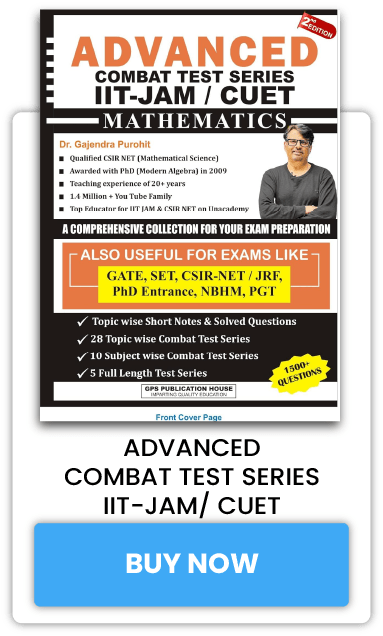
IIT JAM Mathematics Books By GP Sir
Best Books for IIT JAM 2026 Preparation – Top MathsCare resources, paper pattern, tips, and strategies to excel in IIT JAM Mathematics exam.
IIT JAM Expected Difficulty
The Mathematics paper in IIT JAM usually ranges from moderate to high difficulty.
MCQs often test conceptual precision and are prone to tricky framing.
MSQs require strong conceptual knowledge as multiple correct answers are possible.
NAT questions demand quick calculations and careful accuracy. Future exams may focus more on application-based and analytical reasoning questions.
Conclusion
Cracking IIT JAM Mathematics requires a disciplined approach, clear conceptual understanding, and consistent practice. By following a subject-wise strategy, revising regularly, and taking mock tests, aspirants can enhance their chances of securing a top rank. Start preparation early, stay consistent, and keep your study plan structured to maximize results.
IIT JAM FAQS
You can re-download and print the Admit Card from the JAM 2025 portal. No duplicate hard copies will be issued.
For any queries or issues, you can contact the JAM Organizing Committee through their official email or helpline numbers provided on the JAM website.
Candidates belonging to reserved categories (SC, ST, OBC-NCL, PwD) are eligible for seat reservations according to government regulations.
Instructions during the exam will be displayed on the computer screen. No verbal instructions will be given during the exam.
JAM does not allow for re-evaluation or rechecking of exam papers, as they are evaluated using a computerized process.
BEST OFFERING COURSES FOR YOU
BEST BOOKS FOR IIT JAM/ CSIR-NET
BUY BOOKS ON OUR APP