CSIR NET 2026 Mathematics Candidates Appeared
CSIR NET (Council of Scientific and Industrial Research National Eligibility Test): The CSIR NET Mathematics Syllabus 2026 forms the backbone of preparation for aspirants targeting Junior Research Fellowship (JRF) and Assistant Professor eligibility. A clear understanding of the official syllabus is essential, as CSIR NET is a concept-heavy and analytical examination where success depends on depth rather than rote learning.
In this blog, we present the official CSIR NET Mathematical Sciences syllabus exactly as prescribed, along with an overview of the paper pattern, marking scheme, eligibility criteria, and preparation tips to help aspirants plan their studies effectively.
ABOUT CSIR NET MATHEMATICS
CSIR NET (Council of Scientific and Industrial Research – National Eligibility Test) is conducted to determine eligibility for JRF and Lectureship/Assistant Professor in Indian universities and colleges. The Mathematical Sciences paper is designed to test strong foundations in pure and applied mathematics along with problem-solving ability and analytical reasoning.
The syllabus for CSIR NET Mathematics is common for Part B and Part C, and it is divided into four major units covering Analysis, Algebra, Topology, Differential Equations, Mechanics, and Statistics.
CSIR NET MATHEMATICS PAPER PATTERN
The CSIR NET Mathematics paper consists of three parts:
Part A: General Aptitude (common for all subjects)
Part B: Subject-based questions testing fundamental concepts
Part C: Higher-order analytical and problem-solving questions
The exam is conducted in Computer-Based Test (CBT) mode for a duration of 3 hours. Candidates are required to attempt a limited number of questions from each part as specified in the exam instructions.
CSIR NET MATHEMATICS SYLLABUS 2026 (OFFICIAL)
Below is the official syllabus quoted exactly as per the CSIR-UGC NET notification
UNIT – I
Analysis: Elementary set theory, finite, countable and uncountable sets, Real number system as a complete ordered field, Archimedean property, supremum, infimum.
Sequences and series, convergence, limsup, liminf.
Bolzano Weierstrass theorem, Heine Borel theorem.
Continuity, uniform continuity, differentiability, mean value theorem.
Sequences and series of functions, uniform convergence.
Riemann sums and Riemann integral, Improper Integrals.
Monotonic functions, types of discontinuity, functions of bounded variation, Lebesgue measure, Lebesgue integral.
Functions of several variables, directional derivative, partial derivative, derivative as a linear transformation, inverse and implicit function theorems.
Metric spaces, compactness, connectedness. Normed linear Spaces. Spaces of continuous functions as examples.
Linear Algebra: Vector spaces, subspaces, linear dependence, basis, dimension, algebra of linear transformations.
Algebra of matrices, rank and determinant of matrices, linear equations.
Eigenvalues and eigenvectors, Cayley-Hamilton theorem.
Matrix representation of linear transformations. Change of basis, canonical forms, diagonal forms, triangular forms, Jordan forms.
Inner product spaces, orthonormal basis.
Quadratic forms, reduction and classification of quadratic forms.
UNIT – II
Complex Analysis: Algebra of complex numbers, the complex plane, polynomials, power series, transcendental functions such as exponential, trigonometric and hyperbolic functions.
Analytic functions, Cauchy-Riemann equations.
Contour integral, Cauchy’s theorem, Cauchy’s integral formula, Liouville’s theorem, Maximum modulus principle, Schwarz lemma, Open mapping theorem.
Taylor series, Laurent series, calculus of residues.
Conformal mappings, Mobius transformations.
Algebra: Permutations, combinations, pigeon-hole principle, inclusion-exclusion principle, derangements.
Fundamental theorem of arithmetic, divisibility in Z, congruences, Chinese Remainder Theorem, Euler’s Ø-function, primitive roots.
Groups, subgroups, normal subgroups, quotient groups, homomorphisms, cyclic groups, permutation groups, Cayley’s theorem, class equations, Sylow theorems.
Rings, ideals, prime and maximal ideals, quotient rings, unique factorization domain, principal ideal domain, Euclidean domain.
Polynomial rings and irreducibility criteria.
Fields, finite fields, field extensions, Galois Theory.
Topology: basis, dense sets, subspace and product topology, separation axioms, connectedness and compactness.
UNIT – III
Ordinary Differential Equations (ODEs): Existence and uniqueness of solutions of initial value problems for first order ordinary differential equations, singular solutions of first order ODEs, system of first order ODEs.
General theory of homogenous and non-homogeneous linear ODEs, variation of parameters, Sturm-Liouville boundary value problem, Green’s function.
Partial Differential Equations (PDEs): Lagrange and Charpit methods for solving first order PDEs, Cauchy problem for first order PDEs. Classification of second order PDEs, General solution of higher order PDEs with constant coefficients, Method of separation of variables for Laplace, Heat and Wave equations.
Numerical Analysis: Numerical solutions of algebraic equations, Method of iteration and Newton-Raphson method, Rate of convergence, Solution of systems of linear algebraic equations using Gauss elimination and Gauss-Seidel methods, Finite differences, Lagrange, Hermite and spline interpolation, Numerical differentiation and integration, Numerical solutions of ODEs using Picard, Euler, modified Euler and Runge-Kutta methods.
Calculus of Variations: Variation of a functional, Euler-Lagrange equation, Necessary and sufficient conditions for extrema. Variational methods for boundary value problems in ordinary and partial differential equations.
Linear Integral Equations: Linear integral equation of the first and second kind of Fredholm and Volterra type, Solutions with separable kernels. Characteristic numbers and eigenfunctions, resolvent kernel.
Classical Mechanics: Generalized coordinates, Lagrange’s equations, Hamilton’s canonical equations, Hamilton’s principle and principle of least action, Two-dimensional motion of rigid bodies, Euler’s dynamical equations for the motion of a rigid body about an axis, theory of small oscillations.
UNIT – IV
Statistics & Probability: Descriptive statistics, exploratory data analysis.
Sample space, discrete probability, independent events, Bayes theorem. Random variables and distribution functions (univariate and multivariate); expectation and moments.
Independent random variables, marginal and conditional distributions. Characteristic functions. Probability inequalities (Tchebyshef, Markov, Jensen).
Modes of convergence, weak and strong laws of large numbers, Central Limit theorems (i.i.d. case).
Markov chains with finite and countable state space, classification of states, limiting behaviour of n-step transition probabilities, stationary distribution, Poisson and birth-and-death processes.
Standard discrete and continuous univariate distributions, sampling distributions, standard errors and asymptotic distributions, distribution of order statistics and range.
Methods of estimation, properties of estimators, confidence intervals. Tests of hypotheses: most powerful and uniformly most powerful tests, likelihood ratio tests.
Analysis of discrete data and chi-square test of goodness of fit. Large sample tests.
Simple nonparametric tests for one and two sample problems, rank correlation and test for independence. Elementary Bayesian inference.
Gauss-Markov models, estimability of parameters, best linear unbiased estimators, confidence intervals, tests for linear hypotheses. Analysis of variance and covariance. Fixed, random and mixed effects models. Simple and multiple linear regression. Elementary regression diagnostics. Logistic regression.
Multivariate normal distribution, Wishart distribution and their properties. Distribution of quadratic forms. Inference for parameters, partial and multiple correlation coefficients and related tests. Data reduction techniques: Principle component analysis, Discriminant analysis, Cluster analysis, Canonical correlation.
Sampling techniques, design of experiments, reliability theory, linear programming, queuing theory.
CSIR NET MATHEMATICS MARKING SCHEME
Part A: +2 marks for each correct answer; -0.5 marks for each incorrect answer.
Part B: +3 marks for each correct answer; -0.75 marks for each incorrect answer.
Part C: +4.75 marks for each correct answer; no negative marking.
CSIR NET MATHEMATICS ELIGIBILITY CRITERIA
Educational Qualification:
MSc or equivalent degree with 55% marks (General category)
50% marks for SC/ST/OBC/PwD categories
Four-year degree holders must have at least 75% marks
Age Limit:
Maximum 30 years for JRF (General category) with relaxation for reserved categories
No age limit for Assistant Professor / Lectureship
Candidates must ensure they satisfy eligibility at the time of result declaration.
PREPARATION STRATEGY FOR CSIR NET MATHEMATICS
Follow the syllabus strictly and avoid irrelevant topics
Focus heavily on Unit I, II, and III for Mathematics students
Do not skip Unit IV (Statistics), as it offers high scoring potential
Practice previous year CSIR NET questions regularly
Maintain short notes for revision
Attempt mock tests to improve speed and accuracy
Conclusion
The CSIR NET Mathematics Syllabus 2026 is vast, deep, and concept-oriented. However, with a clear understanding of the official syllabus and a structured preparation strategy, cracking CSIR NET Mathematics is completely achievable.
A syllabus-driven approach, combined with regular practice and smart revision, is the key to success. Aspirants should treat the syllabus as their roadmap and align every study decision with it for maximum effectiveness.
CSIR NET FAQS
To pass the CSIR NET 2024 Exam, candidates must score at least 33 percent in the general, EWS, and OBC categories and 25 percent in the SC, ST, and PwD categories. The CSIR NET 2024 Dec result will be released on the official website at csirnet.nta.ac.in.
In India, holding a PhD isn’t just a distinction; it’s a formidable advantage. With a staggering below 1% unemployment rate for PhD holders, as reported by Gururo, compared to the national average of 7%, the demand for highly skilled individuals is unmistakable.
Candidates applying for the Junior Research Fellowship (JRF) should not be more than 30 years of age as on the first day of the month i.e., 1/06/2024 in which the UGC NET 2024 exam concludes, that is, June.
The CSIR NET Lectureship pay scale lies between INR 37000 – 67000 per month on average. This may increase up to INR 1,33,000 – 1,41,000 with promotions and experience.
CSIR prescribes CSIR NET Eligibility Criteria 2024 along with the notification in terms of age limit, educational qualification and nationality. CSIR JRF Age Limit is 28 years. Candidates must hold an MSc/BE/Integrated BS-MS/BS four-year degree/BPharma/BTech/MBBS with 55 per cent.
BEST OFFERING COURSES FOR YOU
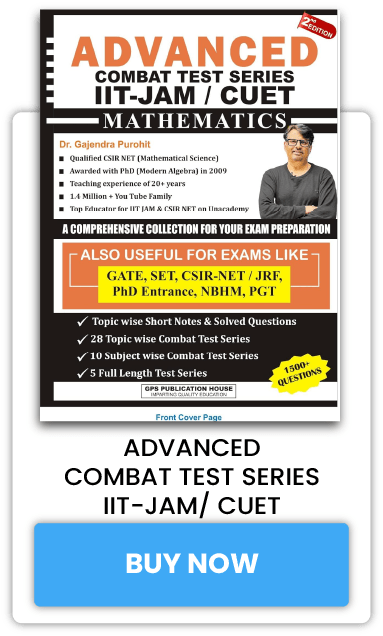
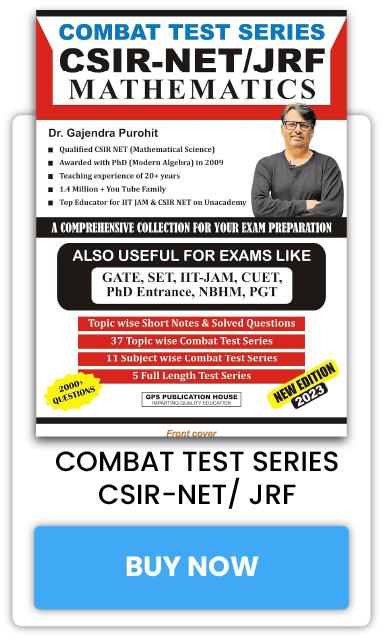
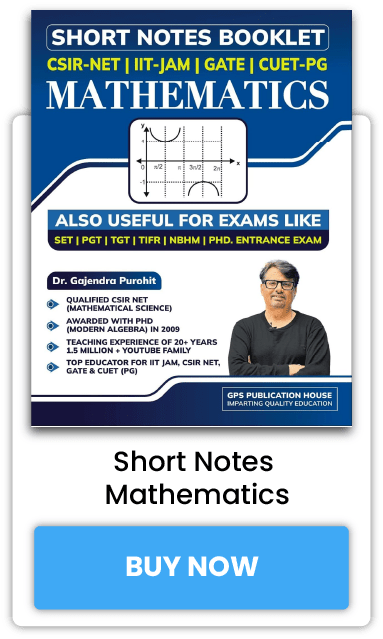
BEST BOOKS FOR IIT JAM/ CSIR-NET

BUY BOOKS ON OUR APP