CSIR NET 2026 Mathematics Candidates Appeared
CSIR NET (Council of Scientific and Industrial Research National Eligibility Test): CSIR NET Mathematics preparation requires focus, planning, and reliable study material. The CSIR NET Mathematics exam evaluates conceptual clarity, problem-solving skills, and analytical ability. Several free CSIR NET Mathematics online resources provide everything you need—lectures, notes, previous year questions, and mock tests. MathsCare by Dr. Gajendra Purohit (GP Sir) is one of the most trusted platforms for free, structured CSIR NET preparation.
About CSIR NET Mathematics
The CSIR NET Mathematics exam, conducted by the Council of Scientific and Industrial Research (CSIR) with the National Testing Agency (NTA), determines eligibility for Junior Research Fellowship (JRF) and Assistant Professor positions in Mathematics across India.
Exam Pattern:
Part A: General Aptitude – reasoning, numerical, and basic math.
Part B: Core Mathematics – undergraduate-level concepts.
Part C: Advanced Mathematics – analytical and research-based questions.
The paper totals 200 marks over 3 hours. Negative marking applies to some parts. The exam structure checks both understanding and application of mathematical principles.
CSIR NET Mathematics Eligibility
To appear for the CSIR NET Mathematics exam, candidates must meet these criteria:
Education:
Master’s degree (M.Sc.) in Mathematics, Applied Mathematics, or related subjects like Statistics, Physics, or Engineering Mathematics.
Minimum 55% marks for General/OBC; 50% for SC/ST and PwD.
Age:
For JRF: maximum 28 years (relaxations up to 5 years for SC/ST/Third Gender, 3 years for OBC).
For Lectureship: no upper age limit.
Anyone with a solid mathematics foundation can pursue CSIR NET Mathematics qualification.
CSIR NET Mathematics Syllabus
The CSIR NET Mathematics syllabus covers undergraduate and postgraduate topics. It emphasizes theoretical understanding, logical application, and analytical ability.
UNIT – 1
Analysis:
Real number system, sequences, series, convergence.
Continuity, differentiability, mean value theorem.
Riemann and Lebesgue integrals.
Functions of several variables, directional and partial derivatives.
Metric spaces, compactness, connectedness.
Linear Algebra:
Vector spaces, linear transformations, matrices, rank, determinant.
Eigenvalues, eigenvectors, Cayley-Hamilton theorem.
Canonical forms (Diagonal, Triangular, Jordan).
Inner product spaces, orthonormal basis, quadratic forms.
UNIT – 2
Complex Analysis:
Complex numbers, analytic functions, Cauchy-Riemann equations.
Contour integrals, Cauchy’s theorems, residue theorem.
Power series (Taylor, Laurent), conformal mappings.
Algebra:
Number theory (divisibility, congruences, Chinese Remainder Theorem).
Groups (subgroups, normal subgroups, quotient groups, homomorphisms, Sylow theorems).
Rings (ideals, quotient rings, UFD, PID, ED, polynomial rings).
Fields, field extensions, Galois Theory.
Topology:
Basis, dense sets, subspace and product topology.
Separation axioms, connectedness, and compactness.
UNIT – 3
Ordinary Differential Equations (ODEs):
First-order ODEs (existence, uniqueness, singular solutions, systems).
Linear ODEs (homogeneous/non-homogeneous), variation of parameters, Sturm-Liouville BVP, Green’s function.
Partial Differential Equations (PDEs):
First-order PDEs (Lagrange, Charpit, Cauchy problem).
Classification of second-order PDEs.
General solution of higher-order PDEs, separation of variables (Laplace, Heat, Wave).
Numerical Analysis:
Numerical solutions of algebraic equations (Iteration, Newton-Raphson, convergence).
Solutions of linear systems (Gauss elimination, Gauss-Seidel).
Interpolation (Lagrange, Hermite, Spline), numerical differentiation and integration.
Numerical solutions of ODEs (Picard, Euler, Runge-Kutta).
Calculus of Variations:
Variation of a functional, Euler-Lagrange equation, extrema conditions.
Linear Integral Equations:
Fredholm and Volterra type (first and second kind), separable kernels, resolvent kernel.
Classical Mechanics:
Generalized coordinates, Lagrange’s and Hamilton’s equations, Hamilton’s principle.
Motion of rigid bodies, theory of small oscillations.
UNIT – 4 (Focus for Statistics Students)
Probability & Statistics:
Descriptive statistics, probability, Bayes theorem, random variables (univariate/multivariate).
Distributions, expectation, moments, characteristic functions, probability inequalities.
Modes of convergence, laws of large numbers, Central Limit Theorem.
Markov chains, Poisson, and birth-and-death processes.
Sampling distributions, standard errors, order statistics.
Statistical Inference:
Methods of estimation, properties of estimators, confidence intervals.
Tests of hypotheses (MP, UMP, likelihood ratio, chi-square, large sample, non-parametric).
Elementary Bayesian inference.
Linear Models & Regression:
Gauss-Markov models, linear unbiased estimators, ANOVA, ANCOVA.
Fixed, random, and mixed effects models.
Simple and multiple linear regression, logistic regression.
Multivariate Analysis & Data Reduction:
Multivariate normal distribution, Wishart distribution.
Inference for parameters, correlation coefficients.
PCA, Discriminant analysis, Cluster analysis, Canonical correlation.
Sampling and Design of Experiments:
Sampling techniques (SRS, stratified, systematic, PPS), ratio and regression methods.
Experimental designs (CRD, RBD, LSD, BIBD), factorial experiments.
Reliability, Queuing & Inventory Models:
Hazard function, failure rates, censoring.
Linear Programming (simplex, duality).
Elementary queuing (M/M/1, M/M/C) and inventory models.
Note on Structure:
All students must answer questions from Unit I.
Mathematics students answer additional questions from Unit II and III.
Statistics students answer additional questions from Unit IV.
Best YouTube Channels for CSIR NET Mathematics
Free video lectures are key for CSIR NET Mathematics preparation, and GP Sir’s YouTube channels are among the best sources. They feature live classes, marathon revisions, and solved examples for every major topic.
Top YouTube Channels for CSIR NET Mathematics:
MathsCare TGT-PGT by GP Sir
Gajendra Purohit – GATE/NET/JAM
Gajendra Purohit Main Channel
Class Schedule: Fridays and Saturdays, 10:30 AM. All sessions are recorded for later viewing. With over two million combined subscribers, these channels are trusted by CSIR NET Mathematics aspirants nationwide.
CSIR NET Mathematics Practice Sets and Mock Tests
Practice strengthens concepts. The MathsCare App provides free CSIR NET Mathematics mock tests and topic-wise practice papers that match the real exam format.
Practice Materials:
5 Full-Length Mock Tests: Simulate actual exam conditions.
34+ Topic-Wise Tests: Focused on Linear Algebra, Real Analysis, Differential Equations, etc.
PYQ Practice Sets: Organized by topic and year for efficient revision.
Regular testing improves time management, accuracy, and confidence during CSIR NET Mathematics exams.
Strategy for Using CSIR NET Mathematics Free Resources
To get the most from CSIR NET Mathematics free materials, follow this study routine:
Start with the Foundation Course for conceptual clarity.
Use To-Do Lists to maintain consistency.
Review topics weekly with Short Notes PDFs.
Attempt topic-wise tests after finishing each chapter.
Join live sessions to resolve doubts and reinforce learning.
Consistency and daily practice define success in CSIR NET Mathematics preparation.
Conclusion
CSIR NET preparation doesn’t require paid coaching. Platforms like MathsCare provide everything—from lectures and notes to PYQs and mock tests—completely free. With focus, consistent effort, and smart use of these CSIR NET Mathematics resources, you can clear the exam confidently and take the next step toward a successful academic or research career.
CSIR NET FAQS
To pass the CSIR NET 2024 Exam, candidates must score at least 33 percent in the general, EWS, and OBC categories and 25 percent in the SC, ST, and PwD categories. The CSIR NET 2024 Dec result will be released on the official website at csirnet.nta.ac.in.
In India, holding a PhD isn’t just a distinction; it’s a formidable advantage. With a staggering below 1% unemployment rate for PhD holders, as reported by Gururo, compared to the national average of 7%, the demand for highly skilled individuals is unmistakable.
Candidates applying for the Junior Research Fellowship (JRF) should not be more than 30 years of age as on the first day of the month i.e., 1/06/2024 in which the UGC NET 2024 exam concludes, that is, June.
The CSIR NET Lectureship pay scale lies between INR 37000 – 67000 per month on average. This may increase up to INR 1,33,000 – 1,41,000 with promotions and experience.
CSIR prescribes CSIR NET Eligibility Criteria 2024 along with the notification in terms of age limit, educational qualification and nationality. CSIR JRF Age Limit is 28 years. Candidates must hold an MSc/BE/Integrated BS-MS/BS four-year degree/BPharma/BTech/MBBS with 55 per cent.
BEST OFFERING COURSES FOR YOU
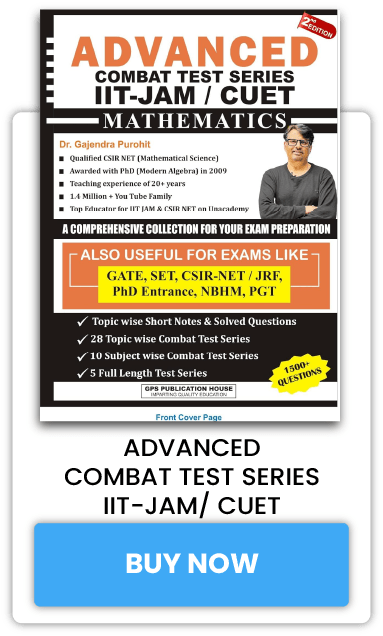
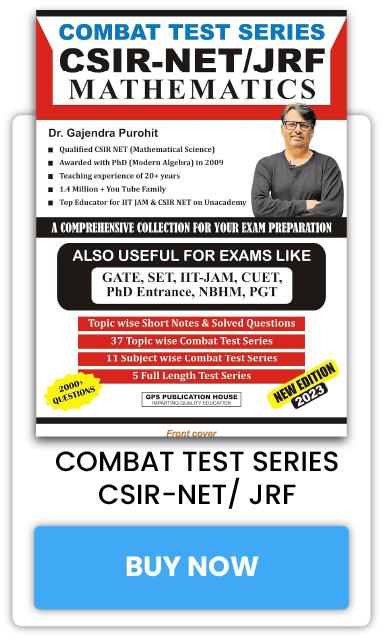
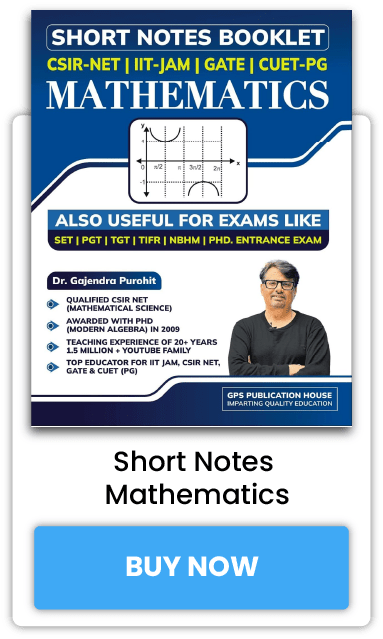
BEST BOOKS FOR IIT JAM/ CSIR-NET

BUY BOOKS ON OUR APP