Linear Algebra for CSIR NET, IIT JAM and GATE Mathematics: Syllabus, Key Results and Solved Examples
Last updated: 20 November 2026 (IST). Syllabus lines are quoted from the CSIR HRDG Mathematical Sciences syllabus, the JAM 2027 Information Brochure and the GATE 2027 Mathematics (MA) syllabus.
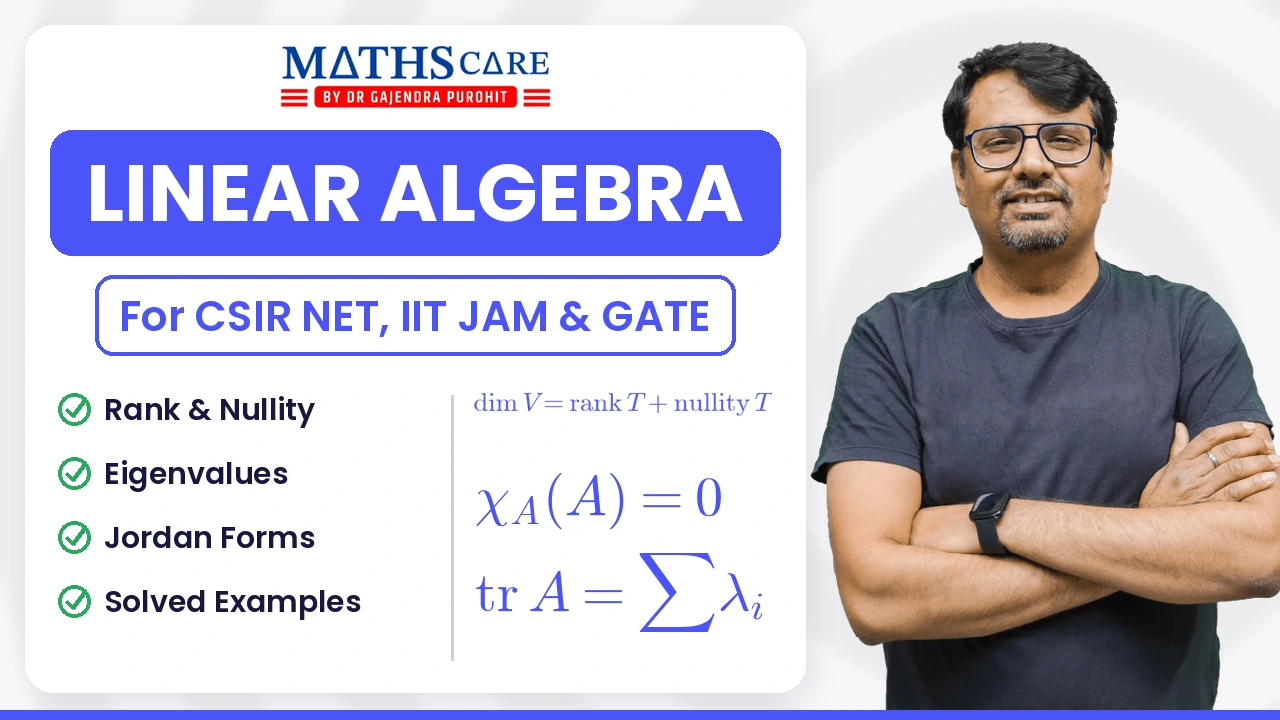
Linear algebra in one paragraph
Linear algebra is the one topic that appears in all three exams MathsCare students take. In CSIR NET Mathematical Sciences it is part of Unit 1, which every candidate answers from. In IIT JAM 2027 Mathematics it is part of Section 3, “Linear Algebra and Algebra”. In GATE 2027 Mathematics it is a full section of its own. Most questions come from a short list of results: the rank–nullity theorem, eigenvalues, trace and determinant, the Cayley–Hamilton theorem, the minimal polynomial and diagonalisability, Jordan forms and quadratic forms. Learn these well, practise them on previous year questions, and linear algebra becomes one of the most reliable scoring topics in the paper.
What each exam’s syllabus says
| Exam | Linear algebra in the official syllabus |
|---|---|
| CSIR NET Mathematical Sciences (Unit 1) | Vector spaces, subspaces, linear dependence, basis, dimension, algebra of linear transformations; algebra of matrices, rank and determinant of matrices, linear equations; eigenvalues and eigenvectors, Cayley–Hamilton theorem; matrix representation of linear transformations, change of basis, canonical forms, diagonal forms, triangular forms, Jordan forms; inner product spaces, orthonormal basis; quadratic forms, reduction and classification of quadratic forms |
| IIT JAM 2027 Mathematics (Section 3) | Matrices: systems of linear equations, rank, nullity, rank–nullity theorem, inverse, determinant, eigenvalues, eigenvectors; finite-dimensional vector spaces: linear independence, basis, dimension, linear transformations, matrix representation, range space, null space, rank–nullity theorem |
| GATE 2027 Mathematics (Section 2) | Finite-dimensional vector spaces over real or complex fields; linear transformations and their matrix representations, rank and nullity; systems of linear equations, characteristic polynomial, eigenvalues and eigenvectors, diagonalization, minimal polynomial, Cayley–Hamilton theorem; finite-dimensional inner product spaces, Gram–Schmidt orthonormalization; symmetric, skew-symmetric, Hermitian, skew-Hermitian, normal, orthogonal and unitary matrices; diagonalization by a unitary matrix; Jordan canonical form; bilinear and quadratic forms |
The JAM syllabus stops at eigenvalues and eigenvectors, so JAM aspirants can skip Jordan forms, inner product spaces and quadratic forms. CSIR NET and GATE need all of them. For the full CSIR NET topic list, see our CSIR NET Mathematics syllabus guide.
The results you should know without thinking
- Rank–nullity. For a linear map \(T: V \to W\) with \(V\) finite-dimensional, \(\dim V = \mathrm{rank} T + \mathrm{nullity} T\). For an \(m \times n\) matrix \(A\), \(\mathrm{rank} A + \dim \ker A = n\).
- Sum of subspaces. \(\dim(U + W) = \dim U + \dim W – \dim(U \cap W)\).
- Trace and determinant. If \(\lambda_1, \dots, \lambda_n\) are the eigenvalues of \(A\) (with algebraic multiplicity, over \(\mathbb{C}\)), then \(\mathrm{tr} A = \sum \lambda_i\) and \(\det A = \prod \lambda_i\). The eigenvalues of \(p(A)\) are \(p(\lambda_i)\) for any polynomial \(p\).
- Cayley–Hamilton. Every square matrix satisfies its characteristic polynomial: if \(\chi_A(x) = \det(xI – A)\), then \(\chi_A(A) = 0\).
- Minimal polynomial. The minimal polynomial \(m_A\) divides \(\chi_A\) and has the same roots. \(A\) is diagonalisable over a field \(F\) if and only if \(m_A\) splits over \(F\) into distinct linear factors.
- Similarity invariants. Similar matrices have the same rank, trace, determinant, characteristic polynomial, minimal polynomial and Jordan form (up to the order of blocks).
- Special matrices. Hermitian (and real symmetric) matrices have real eigenvalues; skew-Hermitian matrices have purely imaginary or zero eigenvalues; unitary (and real orthogonal) matrices have eigenvalues of modulus 1; nilpotent matrices have only the eigenvalue 0; idempotent matrices (\(A^2 = A\)) have eigenvalues in \(\{0, 1\}\). Normal matrices are exactly the ones that can be diagonalised by a unitary matrix.
- Quadratic forms. A real symmetric matrix is positive definite if and only if all its eigenvalues are positive, if and only if all its leading principal minors are positive. The signature counts positive minus negative eigenvalues.
Solved examples in exam style
Example 1: rank–nullity (JAM, CSIR NET)
Question. \(T: \mathbb{R}^5 \to \mathbb{R}^3\) is a linear map onto \(\mathbb{R}^3\). What is \(\dim \ker T\)?
Solution. Onto means \(\mathrm{rank} T = 3\). By rank–nullity, \(\dim \ker T = 5 – 3 = 2\). The same reasoning shows that no linear map from \(\mathbb{R}^3\) to \(\mathbb{R}^5\) can be onto, because its rank is at most 3.
Example 2: consistency of a linear system (JAM)
Question. For which \(\lambda, \mu\) does the system \(x + y + z = 6\), \(x + 2y + 3z = 10\), \(x + 2y + \lambda z = \mu\) have (a) a unique solution, (b) infinitely many solutions, (c) no solution?
Solution. Subtracting the first equation from the second gives \(y + 2z = 4\). Subtracting the second from the third gives \((\lambda – 3)z = \mu – 10\). So the system has a unique solution when \(\lambda \ne 3\); infinitely many when \(\lambda = 3\) and \(\mu = 10\) (the coefficient matrix and the augmented matrix both have rank 2); and no solution when \(\lambda = 3\) and \(\mu \ne 10\) (rank 2 against rank 3).
Example 3: eigenvalues of the all-ones matrix (CSIR NET, GATE)
Question. Let \(J\) be the \(n \times n\) matrix with every entry 1. Find the eigenvalues of \(J\) and \(\det(I + J)\).
Solution. \(J\) has rank 1, so 0 is an eigenvalue with geometric multiplicity \(n – 1\). The vector \((1, 1, \dots, 1)^T\) satisfies \(Jv = nv\), so \(n\) is the remaining eigenvalue (it also matches \(\mathrm{tr} J = n\)). The eigenvalues of \(I + J\) are therefore \(n + 1\) once and \(1\) repeated \(n – 1\) times, so \(\det(I + J) = n + 1\). Since \(J^2 = nJ\), the minimal polynomial of \(J\) is \(x(x – n)\) for \(n \ge 2\), with distinct roots, so \(J\) is diagonalisable.
Example 4: inverse by Cayley–Hamilton (all three exams)
Question. Use the Cayley–Hamilton theorem to find \(A^{-1}\) for \(A = \begin{pmatrix} 1 & 2 \\ 0 & 3 \end{pmatrix}\).
Solution. \(\chi_A(x) = x^2 – (\mathrm{tr} A)x + \det A = x^2 – 4x + 3\). By Cayley–Hamilton, \(A^2 – 4A + 3I = 0\), so \(A(4I – A) = 3I\) and
\[ A^{-1} = \frac{1}{3}(4I – A) = \frac{1}{3}\begin{pmatrix} 3 & -2 \\ 0 & 1 \end{pmatrix}. \]
Example 5: counting Jordan forms (CSIR NET Part C, GATE)
Question. How many similarity classes of \(4 \times 4\) complex nilpotent matrices are there? How many have minimal polynomial \(x^2\)?
Solution. A nilpotent matrix is determined up to similarity by the sizes of its Jordan blocks, which form a partition of 4: \(4,\ 3+1,\ 2+2,\ 2+1+1,\ 1+1+1+1\). So there are 5 classes. The minimal polynomial is \(x^k\), where \(k\) is the largest block size, so minimal polynomial \(x^2\) means the largest block is 2: \(2+2\) or \(2+1+1\), giving 2 classes.
This example also answers a classic trap: those two matrices have the same characteristic polynomial \(x^4\) and the same minimal polynomial \(x^2\), but they are not similar (their ranks are 2 and 1). Equal characteristic and minimal polynomials do force similarity for \(n \le 3\), but not from \(n = 4\) onwards.
Example 6: a real orthogonal matrix fixes a line (CSIR NET, GATE)
Question. Show that every \(3 \times 3\) real orthogonal matrix \(A\) with \(\det A = 1\) has 1 as an eigenvalue.
Solution. Using \(AA^T = I\),
\[ \det(A – I) = \det(A – AA^T) = \det A \cdot \det(I – A^T) = \det(I – A) = (-1)^3 \det(A – I), \]
so \(\det(A – I) = 0\). Geometrically, every rotation of \(\mathbb{R}^3\) has an axis.
Example 7: classifying a quadratic form (CSIR NET, GATE)
Question. Classify \(Q(x, y, z) = 2x^2 + 2y^2 + 2z^2 + 2xy + 2yz + 2zx\).
Solution. The matrix of \(Q\) is \(I + J\) with \(J\) the \(3 \times 3\) all-ones matrix. By Example 3 its eigenvalues are \(4, 1, 1\), all positive, so \(Q\) is positive definite, with rank 3 and signature 3. The leading principal minors \(2,\ 3,\ 4\) confirm this.
True-or-false traps from Part C style questions
| Statement | True or false | Why |
|---|---|---|
| If \(A, B\) are \(n \times n\), then \(AB\) and \(BA\) have the same eigenvalues | True | They have the same characteristic polynomial |
| \(AB\) and \(BA\) have the same minimal polynomial | False | \(A = \begin{pmatrix} 0 & 1 \\ 0 & 0 \end{pmatrix}, B = \begin{pmatrix} 1 & 0 \\ 0 & 0 \end{pmatrix}\): \(AB = 0\) but \(BA \ne 0\) with \((BA)^2 = 0\) |
| A real matrix whose eigenvalues are all real is diagonalisable | False | \(\begin{pmatrix} 0 & 1 \\ 0 & 0 \end{pmatrix}\) has only the eigenvalue 0 but is not zero |
| A matrix with \(n\) distinct eigenvalues is diagonalisable | True | Eigenvectors for distinct eigenvalues are linearly independent |
| If \(A^2 = A\), then \(\mathrm{rank} A = \mathrm{tr} A\) | True | \(A\) is diagonalisable with eigenvalues 0 and 1, and rank counts the 1s |
| Every real symmetric matrix is orthogonally diagonalisable | True | Spectral theorem |
How to prepare linear algebra in four weeks
- Week 1: vector spaces and linear maps. Bases, dimension, subspace sums, rank–nullity and matrix representation. Solve all previous year questions on these first.
- Week 2: matrices and eigenvalues. Rank, systems of equations, determinants, eigenvalues, Cayley–Hamilton and special matrices. JAM aspirants can stop here and revise.
- Week 3: canonical forms. Minimal polynomials, diagonalisability, triangular and Jordan forms, counting similarity classes.
- Week 4: inner products and quadratic forms. Gram–Schmidt, orthogonal and unitary matrices, positive definiteness and signature, then timed mixed practice.
For timed practice, use our CSIR NET Mathematics previous year papers. If you are working towards the December 2026 exam, combine this with the CSIR NET 30-day strategy and keep the CSIR NET December 2026 timeline tracker open for official notices. JAM aspirants can see how linear algebra fits into the rest of the paper in our IIT JAM important topics post. Linear algebra also feeds directly into abstract algebra, where field extensions are studied as vector spaces.
GP Sir’s linear algebra classes
Learn linear algebra with MathsCare
Want live classes, Part C practice and doubt-solving with GP Sir? Message or call the MathsCare team, or see the CSIR NET course details. Preparing for JAM instead? See the IIT JAM Maths course.
Frequently asked questions
Is linear algebra compulsory for CSIR NET Mathematics?
Linear algebra is part of Unit 1 of the CSIR NET Mathematical Sciences syllabus. Unit 1 is the unit every candidate answers questions from, whether they take the mathematics or the statistics route, so it cannot be skipped.
Which linear algebra topics are in the IIT JAM 2027 syllabus?
The JAM 2027 MA syllabus lists systems of linear equations, rank, nullity, the rank–nullity theorem, inverse, determinant, eigenvalues and eigenvectors, and finite-dimensional vector spaces with linear transformations, matrix representation, range space and null space. Jordan forms, inner product spaces and quadratic forms are not listed.
What is the fastest way to check whether a matrix is diagonalisable?
Find the minimal polynomial. A matrix is diagonalisable over a field if and only if its minimal polynomial splits into distinct linear factors there. A quick sufficient check is that an n × n matrix has n distinct eigenvalues, or that it is real symmetric or, more generally, normal.
Do equal characteristic and minimal polynomials mean two matrices are similar?
Only for matrices of size 3 or less. From size 4 onwards it fails: the nilpotent Jordan forms with blocks 2+2 and 2+1+1 share the characteristic polynomial x⁴ and minimal polynomial x² but have different ranks.
Which book is best for linear algebra for CSIR NET?
Hoffman and Kunze’s Linear Algebra is the standard text for the theory, and Gilbert Strang’s Introduction to Linear Algebra is good for computation. Pair either with previous year CSIR NET questions.
Can I contact MathsCare about linear algebra classes?
Yes. Message or call the MathsCare team on WhatsApp at 95710 85397 for details of the CSIR NET, IIT JAM and GATE Mathematics courses.
Official sources
- CSIR NET Mathematical Sciences syllabus: CSIR HRDG; exam notices: csirnet.nta.nic.in
- IIT JAM 2027 Information Brochure: jam.iitkgp.ac.in
- GATE 2027 Mathematics syllabus: gate2027.iitm.ac.in