
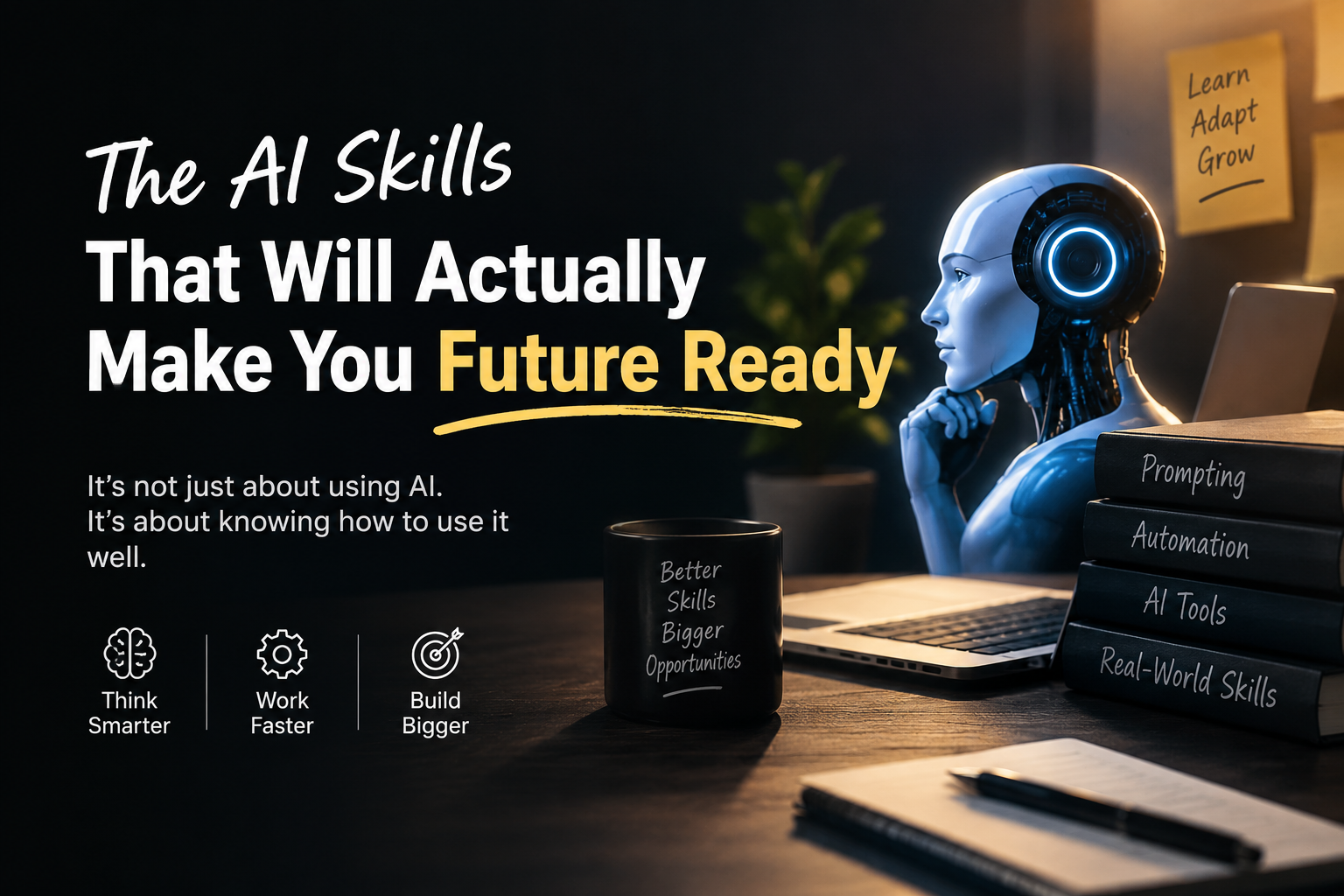
AI Skills for Students: AI Mastery Guide for Smarter Learning
AI skills for students are no longer optional. From learning difficult concepts to preparing for careers, artificial intelligence can help you study with more structure and confidence. But real AI mastery is not about copying answers. It is about asking better questions, checking information and using AI to strengthen your own thinking.
This practical AI mastery guide explains how students can use AI tools for learning, revision, problem-solving and career preparation—while staying accurate, ethical and independent.
What is AI mastery for students?
AI mastery means using artificial-intelligence tools effectively and responsibly. It includes four core skills:
- Clear prompting: explaining exactly what you need.
- Critical thinking: checking answers instead of trusting every response.
- Subject understanding: using AI to learn, not to avoid learning.
- Responsible use: protecting privacy and submitting your own work.
Why AI skills are important for students
AI can personalise learning in ways that traditional notes cannot. You can request a simpler explanation, extra examples, a study plan, practice questions or feedback on your solution. These are valuable AI skills for students because they help you learn at your own pace.
- Get explanations at beginner, intermediate or advanced level.
- Turn a syllabus into a practical revision checklist.
- Create topic-wise quizzes and practice questions.
- Identify gaps in your reasoning after solving a problem.
- Develop useful AI skills for college, competitive exams and future careers.
How to use AI for studying effectively
Use AI to understand concepts
Ask focused questions. For example: “Explain eigenvalues using a simple 3×3 matrix. Then give me three questions to solve without showing the answers.” A clear prompt produces a more useful answer than a broad request such as “teach me mathematics.”
Use AI for practice, not shortcuts
After learning a topic, ask for questions at increasing levels of difficulty. Attempt every problem yourself first. If you are stuck, request a hint, a related theorem or the next step—not the final answer immediately.
Use AI to make a study plan
Share your subjects, target examination, available study hours and deadline. Ask for a weekly plan that includes concept learning, previous-year questions, mock tests and revision. Review the plan each week and change it according to your progress.
Use AI to review mistakes
Maintain an error notebook. Record the topic, your mistake and the correct method. AI can help organise these mistakes into categories, but you should always review the final list and understand the correction.
Five AI prompts every student can use
- “Explain this concept step by step, then ask me five questions to test my understanding.”
- “Create a seven-day revision timetable for these topics, including previous-year-question practice.”
- “Give me hints only for this problem. Do not reveal the final answer unless I ask.”
- “Review my solution and tell me the first step where my reasoning becomes incorrect.”
- “Create ten mixed-difficulty practice questions on this topic, with solutions in a separate section.”
AI tools for mathematics and exam preparation
For mathematics students, AI can be especially helpful when used as a tutor, practice partner and revision planner. Ask for alternative explanations, counterexamples, worked examples and feedback on your method. Then verify the result with your textbook, notes, teacher or your own calculation.
| Best use of AI | How to use it well |
|---|---|
| Concept learning | Request explanations at different levels with examples. |
| Revision planning | Convert your syllabus into daily tasks and review the plan weekly. |
| Question practice | Ask for original questions, then solve them before checking solutions. |
| Error analysis | Use your own answer and ask where the reasoning first goes wrong. |
| Career preparation | Practise research, writing, presentation and structured problem-solving. |
How to verify AI answers
AI tools can make mistakes in calculations, proof steps, facts and current information. Never rely on an answer just because it sounds confident. For important academic or career decisions, verify information through official sources. For mathematics, check each step of the calculation independently.
30-day AI mastery plan
Week 1: learn to write better prompts
Use one AI tool for explanations, one for planning and one for practice. Compare vague prompts with detailed prompts to see how specificity changes the result.
Week 2: apply AI to a real subject
Choose one chapter. Create a checklist, request practice questions and build an error log from a short test.
Week 3: improve critical thinking
Ask for examples, counterexamples, hints and alternative approaches. Check each response against class notes, standard books or reliable sources.
Week 4: build a repeatable learning workflow
Create your own routine: plan, study, practise, review and revise. Keep only the AI tools and prompts that help you learn with more clarity and consistency.
Common AI mistakes students should avoid
- Copying answers without understanding the method.
- Using vague prompts and accepting vague replies.
- Trusting calculations, sources or facts without verification.
- Replacing question practice with reading explanations.
- Entering personal or sensitive information into an AI tool.
Master AI Skills with MathsCare’s AI Mastery Course
Ready to move from basic AI use to practical, career-ready skills? MathsCare’s AI Mastery Course helps you build confidence with prompting, automation, AI tools and real-world applications.
Explore the AI Mastery Course →
Start building AI mastery today
The best AI skills combine technology with strong learning habits. Use AI to ask sharper questions, practise more effectively, check your work and learn from mistakes. When you stay curious and verify what you receive, AI becomes a powerful study partner for exams, college and your future career.
