IIT JAM 2026 Notification Date
IIT JAM 2025 (Joint Admission Test for Masters) As the academic year 2026 approaches, the notification for JAM will be the first official communication outlining all critical exam-related details. For aspirants aiming to crack IIT JAM 2026, understanding the notification date, eligibility, exam format, and syllabus is crucial for timely and well-informed preparation. This blog provides a detailed breakdown of all aspects surrounding the upcoming JAM 2026 notification.
About IIT JAM 2026
IIT JAM tests undergraduate-level knowledge in seven core subjects: Mathematics, Physics, Chemistry, Economics, Geology, Biotechnology, and Mathematical Statistics. It serves as a gateway for admission to highly respected postgraduate programs like MSc, Joint MSc-PhD, MSc-PhD Dual Degree, and Integrated PhD in participating IITs and IISc. The exam evaluates not just academic understanding but also analytical and reasoning abilities. Since JAM is accepted across multiple top-tier institutions, it remains one of the most competitive science entrance exams in India.
Notification Date for IIT JAM 2026
The IIT JAM 2026 notification is anticipated to be released in the first or second week of August 2025, most likely between August 4–10. Historically, the JAM 2025 notification was made public on August 4, 2024, alongside the launch of the official JAM website. The notification typically kicks off the application process through the JAM Online Application Processing System (JOAPS), with form filling opening within a few days of announcement. Candidates are advised to monitor official channels during this time frame to avoid missing crucial updates.
Paper Setting Institute for JAM 2026
Every year, one IIT is selected as the organizing institute for JAM, responsible for conducting the exam and managing all related operations through JOAPS. For JAM 2025, IIT Delhi was the organizing body. For JAM 2026, it is expected—but not officially confirmed—that IIT Roorkee will take charge, following the rotational sequence observed in past years. The organizing institute’s name will be declared in the notification itself. This institute will also manage the publishing of the question papers, answer keys, results, and admission rounds.
IIT JAM 2026 Paper Pattern
The JAM 2026 exam will be held as a Computer-Based Test (CBT) for a total duration of 3 hours, with each subject paper worth 100 marks. The paper includes 60 questions spread across three distinct sections:
Section A: 30 Multiple Choice Questions (MCQs) – Negative marking applies
Section B: 10 Multiple Select Questions (MSQs) – No negative marking
Section C: 20 Numerical Answer Type Questions (NATs) – No negative marking
Candidates may opt to appear for either one or two test papers, depending on the combinations permitted for that year. The exam is conducted exclusively in English and requires strong conceptual understanding and accuracy.
Eligibility for IIT JAM 2026
To be eligible for JAM 2026, candidates must:
Hold a bachelor’s degree in any discipline with relevant subject knowledge
No age limit is applicable for appearing in the exam
No minimum percentage or CGPA is required to qualify
Foreign nationals may apply if their degree is recognized in India and satisfies institute-specific criteria
Candidates are also required to meet Eligibility Requirements (ERs) and Minimum Educational Qualifications (MEQs) specific to the programs offered by various IITs and IISc. The complete list will be published in the official admission brochure.
Application Form Fee for JAM 2026 (Expected)
The application fee is likely to follow the JAM 2025 structure, which is:
Female / SC / ST / PwD candidates: ₹900 for one paper, ₹1250 for two papers
All other candidates: ₹1800 for one paper, ₹2500 for two papers
The fee must be paid online using credit card, debit card, or net banking. Late applications or incorrect form details may incur additional fees during the correction window.
IIT JAM 2026 Mathematics Syllabus
The Mathematics paper for JAM 2026 is expected to include core undergraduate topics. The official syllabus includes:
Real Analysis
Sequences and Series of Real Numbers:
Topics include convergence of sequences, bounded and monotonic sequences, and Cauchy sequences. Important theorems such as the Bolzano-Weierstrass theorem and the concept of absolute convergence are covered. Methods for testing series convergence include the comparison test, ratio test, and root test. Power series (in one real variable) are examined, with focus on radius and interval of convergence, as well as term-by-term differentiation and integration.
Functions of a Single Real Variable:
Key concepts include limits, continuity, and the intermediate value property. Differentiation techniques and results such as Rolle’s Theorem, the Mean Value Theorem, L’Hospital’s Rule, and Taylor’s Theorem (including Taylor series) are included. The study also covers maxima and minima, along with Riemann integration—covering definite integrals, their properties, and the Fundamental Theorem of Calculus.
Multivariable Calculus and Differential Equations
Functions of Two or Three Variables:
Explores limits, continuity, partial derivatives, total derivatives, and the determination of local extrema (maxima and minima) in multivariable settings.
Integral Calculus:
Covers double and triple integrals, changing the order of integration, and applications such as computing surface areas and volumes via double integrals, and volumes using triple integrals.
Differential Equations:
Includes first-order equations like Bernoulli’s equation, exact equations, use of integrating factors, and orthogonal trajectories. Also covered are homogeneous equations, separation of variables, second-order linear differential equations with constant coefficients, the method of variation of parameters, and the Cauchy-Euler equation.
Linear Algebra and Algebra
Matrices:
Focuses on systems of linear equations, matrix rank and nullity, the rank-nullity theorem, matrix inverses, determinants, and eigenvalues and eigenvectors.
Finite-Dimensional Vector Spaces:
Topics include linear independence, basis and dimension, linear transformations and their matrix representations, as well as range and null spaces. The rank-nullity theorem is revisited in this context.
Groups:
Covers fundamental group theory concepts such as cyclic, abelian, and non-abelian groups; permutation groups; normal subgroups and quotient groups; and Lagrange’s theorem for finite groups.
A deep understanding of these topics, along with consistent practice, is essential for securing a strong rank.
IIT JAM 2026 Preparation Tips
Start Early: Begin preparation 6–8 months before the exam
Understand the Syllabus: Break down the syllabus into weekly goals
Use Trusted Resources: Stick to standard textbooks and previous year question banks
Mock Tests & Time Management: Attempt full-length mocks to improve speed and accuracy
Revision: Allocate the last 4–6 weeks exclusively to revision, formula sheets, and weak topic reinforcement
Forming a well-structured, consistent study plan from now until February 2026 will significantly improve your chances of cracking the exam.
Conclusion
The IIT JAM 2026 notification, expected in the first or second week of August 2025, marks the beginning of the formal exam cycle. With IIT Roorkee likely to organize the exam and a comprehensive syllabus rooted in UG fundamentals, early awareness and preparation are key. Bookmark the official JAM portal, prepare your documents, and begin studying smartly. A timely, informed approach is your best asset for securing a top rank and admission to India’s most prestigious science institutions.
IIT JAM FAQS
You can re-download and print the Admit Card from the JAM 2025 portal. No duplicate hard copies will be issued.
For any queries or issues, you can contact the JAM Organizing Committee through their official email or helpline numbers provided on the JAM website.
Candidates belonging to reserved categories (SC, ST, OBC-NCL, PwD) are eligible for seat reservations according to government regulations.
Instructions during the exam will be displayed on the computer screen. No verbal instructions will be given during the exam.
JAM does not allow for re-evaluation or rechecking of exam papers, as they are evaluated using a computerized process.
BEST OFFERING COURSES FOR YOU
BEST BOOKS FOR IIT JAM/ CSIR-NET
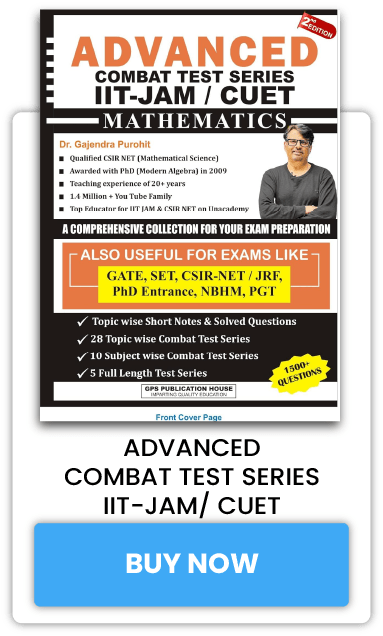
BUY BOOKS ON OUR APP